








In short
- The traffic law (ZOBS) has no article on dash cams. I read the consolidated text and found none, so a camera itself is not banned there.
- The 2025 data-protection law (Official Gazette 12/25) exempts purely personal use (Art. 5(2)) and sets rules for video surveillance of a space (Art. 57). It does not name dash cams.
- The money risk sits with the phone: using a phone or device against Art. 33 costs 200–400 KM (€102.26–€204.52).
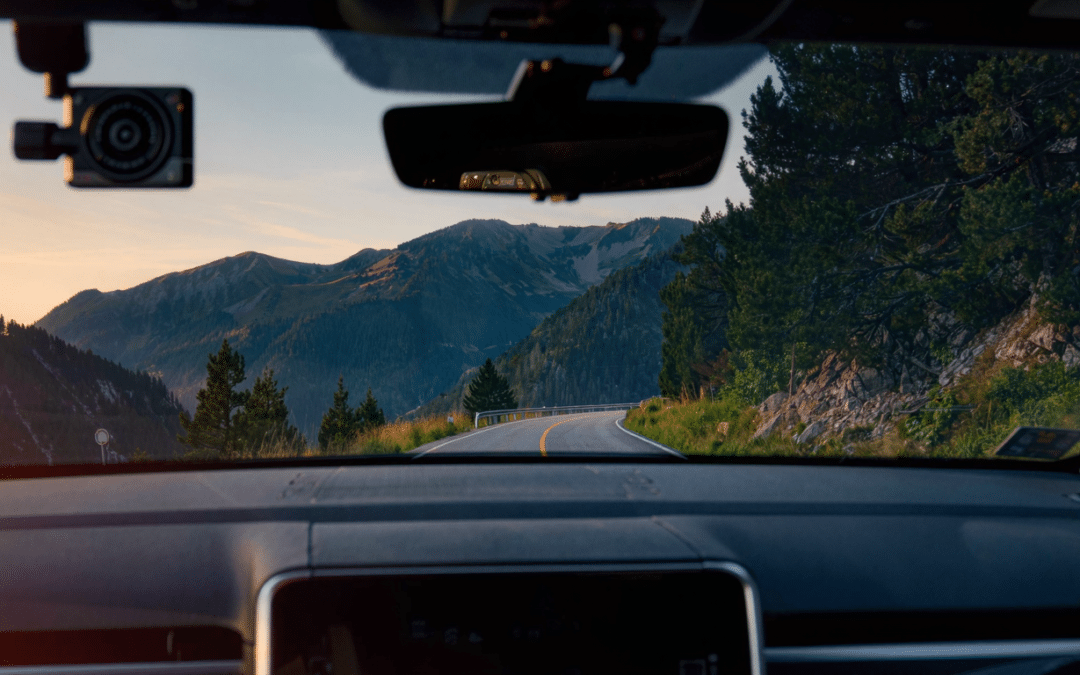
You fit a dash cam for insurance disputes and for the day someone cuts you off. In Bosnia and Herzegovina two laws touch that camera: the traffic law and the data law. One is silent about cameras. The other is detailed, but it was not written with your windscreen in mind.
What the traffic law says
The Law on the Basics of Road Traffic Safety in BiH (ZOBS, Official Gazette of BiH 6/06 and later amendments, the latest 35/26) has no article about cameras in vehicles. I went through the text for any rule on recording devices. There is none. A dash cam is neither banned nor licensed by the traffic law.
What does apply is Article 33(1). While the vehicle is moving, you may not use a mobile phone or another communication device unless you have, and use, equipment that lets you communicate without your hands. The same paragraph bans audio and video devices used so that you cannot hear the sound signals of other road users, and it bans “other actions that disturb your attention” while driving. Paragraph 2 says a vehicle stopped at a red light or for a priority vehicle still counts as moving.
The law does not say how to run a camera. It says what you may not do while driving. Fiddling with a camera or a phone-camera menu on the move is the kind of action that last clause is about. That is my reading of the wording; I found no official text that applies it to cameras.
What the data law says
The Law on Personal Data Protection (Official Gazette of BiH 12/25) was adopted by Parliament on 23 and 30 January 2025. It applies 210 days after it entered into force (Art. 120), and that period ran out in 2025. It is aligned with the EU GDPR (Art. 1(2)). Three provisions matter here:
- Art. 4(dd) defines video surveillance as an information and communication system that can collect and further process personal data and creates a recording that is, or is meant to be, part of a storage system.
- Art. 5(2) says the law does not apply to processing by a natural person exclusively for personal or household purposes.
- Art. 57(1) allows monitoring of a defined space by video surveillance only if it is necessary to protect persons and property and the interests of the data subject do not prevail. Art. 57(5) requires a visible notice. Art. 57(3) names public transport vehicles.
None of these texts mentions dash cams. Art. 57 is written for the monitoring of a space. Whether a camera on a private car falls under Art. 57 or under the personal-use exemption in Art. 5(2) is not answered by the text. I also looked at the published opinions of the Data Protection Agency (AZLP). They include video surveillance in a kindergarten, but none on cameras in vehicles. So I will not give you a ruling the officials have not given.
- Bosnia and Herzegovina: children under 12 do not ride in the front seat, and the rear seat has age rules of its own
- Bosnia and Herzegovina: with a roof box and bikes on the back, lights and plate stay visible and overhang is capped
- Bosnia and Herzegovina: aftermarket LED and xenon bulbs, spotlights and roof bars under the vehicle rulebook
Fines
- Using a phone or device against Art. 33: 200–400 KM (€102.26–€204.52), Art. 235a(1)(1) ZOBS.
- The same offence when it causes an accident: 400–2,000 KM (€204.52–€1,022.58), a driving ban of one to six months and two penalty points, Art. 235a(2).
- Processing personal data against the basic principles of Art. 7 of the data law: from 20,000 KM (€10,225.84), Art. 113(5)(a). This is aimed at data controllers, and purely personal use is outside the law.
Foreign drivers and rental cars
The offence lines in Art. 235a speak of “the driver”, with no distinction by number plate. The data law applies to controllers based in BiH, and to foreign controllers only when they offer goods or services to people in BiH or monitor their behaviour in BiH (Art. 6). I found no official text on cameras inside rental cars.
Mistakes I see most often
- Using the phone as the dash cam and touching it while the car rolls. Art. 33 is written for phones.
- Treating “personal use” as a blanket permission. Art. 5(2) says “exclusively” personal or household purposes.
- Keeping every recording forever. The data law lists storage limitation as a principle (Art. 7(1)(e)): keep data no longer than the purpose needs.
Do the math: Do the math: a phone-based camera that you handle while driving risks 200 KM (€102.26) at the minimum, and up to 2,000 KM (€1,022.58) if it ends in a crash. Setting the camera up before you move costs you nothing in fines.
FAQ
Is a dash cam legal in Bosnia and Herzegovina? The traffic law does not mention it and I found no ban in the text. The data law does not name it either, and its application to private cars is not spelled out.
Do I need a sign on the car? Art. 57(5) requires a visible notice for video surveillance by a controller. I found no official text that requires a sticker for a personal dash cam.
Can my phone be my dash cam? The phone rules of Art. 33 apply to the phone. Mount it, start it before you drive and leave it alone.
Where to check
The ZOBS text in the Official Gazette of BiH (Art. 33, 235a), the Law on Personal Data Protection 12/25 (Art. 5, 57, 113) and the Data Protection Agency at azlp.ba.
Ivan’s Take
My rule: mount it, start it before you move, never touch it while rolling. The traffic law is silent about the camera and loud about handling devices. The data law was not written for your windscreen, so I would not publish footage that shows other people’s faces or plates.
Sources: Zakon o osnovama sigurnosti saobraćaja na putevima u BiH (Službeni glasnik BiH 6/06 … 88/23; izmjene 35/26), čl. 33, 235a; Zakon o izmjenama i dopunama ZOBS, Službeni glasnik BiH 35/26; Zakon o zaštiti ličnih podataka, Službeni glasnik BiH 12/25 (čl. 4, 5, 7, 57, 113, 120); Agencija za zaštitu ličnih podataka u BiH (AZLP); Centralna banka BiH, kurs 1 EUR = 1,95583 KM.
Published:
More from this section
The AvtoGear weekly
Once a week: new tests, the best deals and one useful tip for your car. Nothing extra.
