








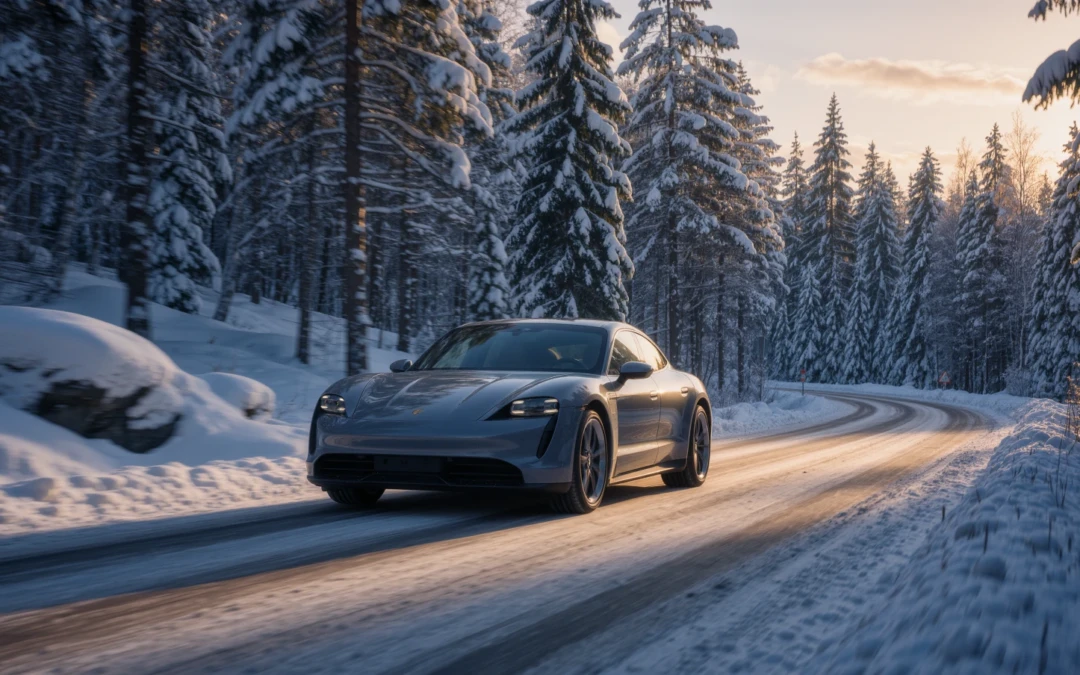
In short
- From 1 December to 31 March a car must have winter tyres or equivalent equipment when winter road conditions apply. Tread must be at least 3 mm.
- Studded tyres are allowed from 1 October to 15 April, and outside those dates only if winter conditions exist or are expected. You may not mix studded and non-studded tyres on a car.
- Driving without winter tyres when required is a 2,000 SEK fine (about €180.80).
Sweden does not ask for winter tyres all winter. It asks for them when the road is wintry, inside a fixed period. That sounds relaxed until the police decide that a patch of frost counts. I read chapter 4, sections 18 a to 18 d of the Traffic Regulation (1998:1276, amended up to SFS 2026:1052, tyre rules as changed by SFS 2025:881), the Transport Agency’s winter tyre page and the prosecutor’s fine catalogue (SFS 2024:1084, annexes 1A and 1B).
The rule for cars
Under chapter 4, section 18 a, between 1 December and 31 March the following must have winter tyres or equivalent equipment when winter road conditions apply: passenger cars, light lorries, light buses, tractors built from a converted car, and trailers pulled by them. The Transport Agency explains that winter road conditions mean snow, ice, slush or frost on any part of the road, and that the police decide whether they apply where you are.
The minimum tread depth in that period is 3 mm. For a heavier class II passenger car over 3,500 kg total weight the minimum is 5 mm. Winter tyres may be studded or non-studded. Non-studded winter tyres must carry the alpine peak and snowflake symbol. Ice-grip marking is optional.
Studded tyres
Studs are allowed from 1 October to 15 April. If winter conditions exist or are expected, you may use them before or after those dates too. A car or light lorry may not use studded and non-studded tyres together. A trailer pulled by a car with studs must also have studs. A car on non-studded tyres may pull a trailer with studs.
- Sweden: recovery tow at 40 km/h on a special towing dolly from 1 December 2026
- Sweden: Environmental Zones, Euro Classes and the Emission Papers You Must Carry (Fine 1,000 SEK)
- Sweden: the väjningsplikt rules – give way from the right, in the circle and to pedestrians, and what a mistake costs (€90–271)
Exceptions
Section 18 c lets you drive without winter tyres if it can be done without danger to road safety, in these cases: test driving or towing the vehicle for repair, driving the shortest suitable route to and from the nearest inspection station, and vehicles that the vehicle register shows are of a model year thirty years old or more. The Transport Agency’s page also lists tyres with a rim diameter of 10 inches or less as exempt.
Heavy vehicles
Heavy lorries, heavy buses and their trailers must have winter tyres from 10 November to 10 April whether or not the road is wintry (section 18 b). Tread must be at least 5 mm. This is outside the scope of most readers.
Fines
Amounts are from the prosecutor’s catalogue (SFS 2024:1084, annex 1A item 12 and annex 1B item 3). Conversion at the Riksbank rate of 11.0628 SEK per euro on 12 November 2026.
- No winter tyres when required (car, light lorry, light bus, trailer): 2,000 SEK (about €180.80)
- Insufficient tyre tread: 1,200 SEK (about €108.50)
- Damaged tyre with exposed cords: 3,000 SEK (about €271.20)
- Mix of studded and non-studded tyres: 1,000 SEK (about €90.40)
- Trailer without studs behind a car with studs: 1,000 SEK (about €90.40)
- Studded tyres outside the allowed period: 500 SEK (about €45.20)
Foreign drivers and rental cars
The rule is written for vehicles driven on a road in Sweden. In the text and the catalogue I read there is no exception for foreign registration. A rental car from a Swedish company is normally equipped for the season, but it is your job as the driver to check the tyres before you set off. If you arrive in your own car from a mild country, change tyres before the border, because a frosty morning in a Swedish forest is enough.
Mistakes I see most often
- Waiting for 1 December to change tyres after the first snow has already fallen. The legal start is 1 December, but a skid does not wait for the date.
- Winter tyres worn below 3 mm. They do not meet the rule in the winter period.
- A mixed set: two studded, two plain.
Do the math: Driving on summer tyres on a frosty road in January: 2,000 SEK (about €181). If the tyres are also worn, add 1,200 SEK (about €108). Fined together, the catalogue adds 50 percent of the lower amount to the higher one (3 §): 2,600 SEK (about €235) before any damage, and the car handles worst exactly when you need it.
FAQ
Are all-season tyres legal in Sweden? The marking rule says non-studded winter tyres must carry the alpine peak and snowflake symbol. A tyre without that symbol does not meet it. Check the sidewall.
Do I need snow chains? The rules I read name winter tyres or equivalent equipment, and I did not verify chains as a separate duty, so I make no claim about them.
Who decides whether it is winter road conditions? The Transport Agency states that the police decide at the place where you are.
Where to check
Trafikförordning 1998:1276, chapter 4, sections 18 a to 18 e, at riksdagen.se; transportstyrelsen.se (Vinterdäck); Ordningsbötskatalog at aklagare.se.
Ivan’s Take
If you drive in Sweden between December and March, put winter tyres on and stop arguing with the calendar. The fine is 2,000 SEK, but the real cost is a car that will not stop on ice. Swedes change tyres in autumn without being told. Do the same.
Sources: Trafikförordning (1998:1276), 4 kap. 18 a–18 e §§ – riksdagen.se; Transportstyrelsen – Vinterdäck; Åklagarmyndigheten – Ordningsbotskatalog, bilaga 1A och 1B (SFS 2024:1084); Riksbank – SEK/EUR 12.11.2026.
Published:
More from this section

The AvtoGear weekly
Once a week: new tests, the best deals and one useful tip for your car. Nothing extra.
