








In short
- A car in use in Sweden must have a warning triangle. If it is missing the fine is 500 SEK (about €45.20). If you break down on a road with a limit above 50 km/h and do not set it out, it is 800 SEK (about €72.30).
- The official fine catalogue names lights, brakes, belts, horn, wipers, mirrors and tyres. Seat belts missing or defective cost 1,500 SEK (about €135.60), insufficient tyre tread 1,200 SEK (about €108.50).
- The catalogue has no entry for a reflective vest, first-aid kit or fire extinguisher in a passenger car.
Swedish rules on car equipment are in the Vehicle Regulation and in technical rules from the Transport Agency. What matters to you as a driver is the list of fines. I read the Traffic Regulation (1998:1276, amended up to SFS 2026:1052), the Vehicle Regulation (2009:211, up to SFS 2025:1571) and the prosecutor’s fine catalogue, annexes 1A and 1B (SFS 2024:1084, amended by SFS 2025:917 and 2025:909).
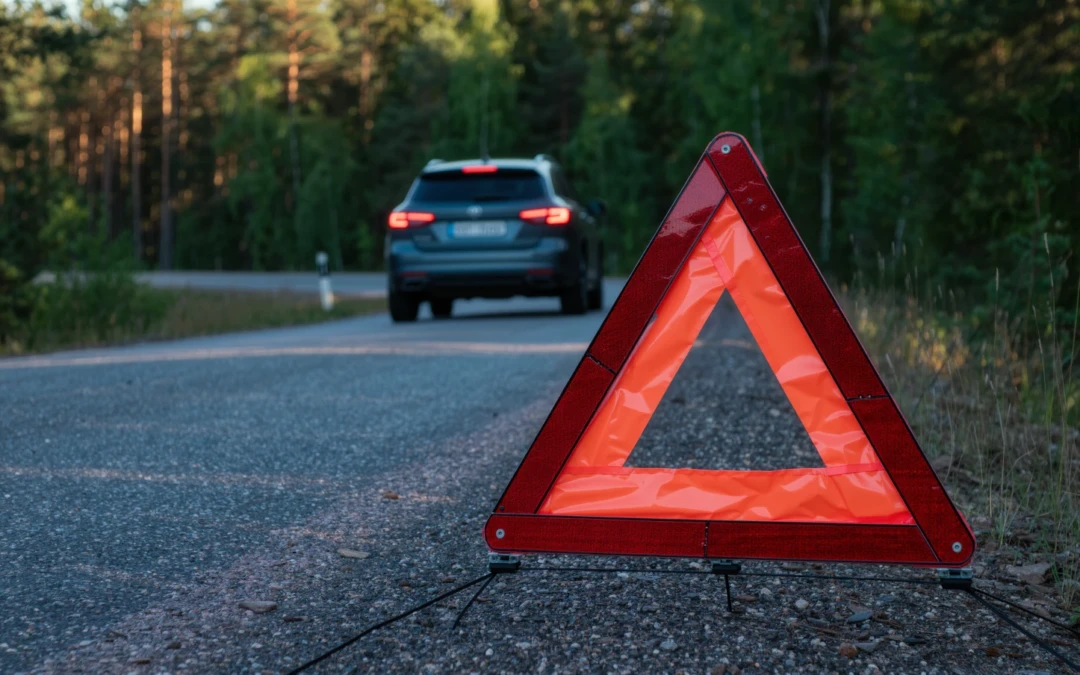
The warning triangle
The catalogue lists the missing triangle as a fault on cars and trailers towed by cars: ‘Varningstriangel saknas vid användning’, 500 SEK. It applies both to cars taken into use from 1 July 2010 and to older ones. The technical details sit in the Transport Agency’s regulations TSFS 2016:22 and 2013:63, which I did not read in full, so I only quote what the catalogue says.
The duty to use it is in chapter 3, section 57 of the Traffic Regulation. If your vehicle has stopped on the carriageway or the verge because of an accident, an engine fault or something similar, where the speed limit is above 50 km/h and stopping is not otherwise allowed, you must put out the triangle. You must also put it out when you park on the carriageway for another reason and weather or other conditions make it hard for others to see you in time. The triangle must be of the type prescribed for the vehicle and placed far enough away to warn others in good time. If you stop on a level crossing and cannot move at once, you must also take the steps needed to protect passengers and warn train drivers.
Not setting out the triangle, or setting it out wrongly, costs 800 SEK (about €72.30).
Fines for equipment faults (cars from 1 July 2010)
These amounts are from annex 1B of the prosecutor’s catalogue. Conversion at the Riksbank rate of 11.0628 SEK per euro on 12 November 2026.
- Warning triangle missing: 500 SEK (about €45.20)
- Seat belts missing or defective: 1,500 SEK (about €135.60)
- All headlights missing or not working: 1,500 SEK (about €135.60), and 3,000 SEK (about €271.20) in difficult light or visibility
- One or more headlights missing or not working: 1,000 SEK (about €90.40)
- Indicators missing or not working: 1,000 SEK (about €90.40)
- Brake lights: all not working 1,500 SEK (about €135.60), one or more 1,000 SEK (about €90.40)
- Number plate light, horn, mirrors, wipers, washers, mudguards, speedometer: 500 SEK (about €45.20) each
- Brakes or steering not effective: 3,000 SEK (about €271.20)
- Illegal film or tint on the windscreen or front side windows: 500 SEK (about €45.20)
The same annex lists tyre faults: insufficient tread 1,200 SEK (about €108.50), damaged tyre with exposed cords 3,000 SEK (about €271.20). Winter tyre rules have their own article on this site.
What the list does not name
I searched annexes 1A and 1B for a reflective vest, a first-aid kit, a fire extinguisher and a torch. None of them appears. That means the catalogue gives no fine for lacking them in a passenger car. It does not mean they are a bad idea. I did not find a separate official rule that requires them, so I do not claim one.
Foreign drivers and rental cars
The Swedish list applies to any car on a Swedish road. A rental car must meet the same rules, so check the triangle and the lights before you drive off. If your own foreign car is legal and works properly, the practical risks are the triangle and working lights.
Mistakes I see most often
- Driving without a triangle in a rented car because it is ‘never needed’.
- A dead bulb found only at a roadside check, often a brake or number plate light.
- Putting the triangle right behind the car instead of far enough back.
Do the math: No triangle in the car: 500 SEK (about €45). Triangle in the boot but not put out on a fast road: 800 SEK (about €72). Failed brakes or steering: 3,000 SEK (about €271). A triangle is a one-off purchase that you keep for years.
FAQ
Is a reflective vest compulsory in Sweden? I found no entry for it in the official fine catalogue for passenger cars. Having one is still sensible when you step out on a road.
When must I put out the triangle? When you stop on the carriageway or verge after an accident or breakdown where the limit is above 50 km/h, or when you are parked on the road and others cannot see you in time.
Do I need a fire extinguisher or first-aid kit? The catalogue names neither for a passenger car.
Where to check
Trafikförordning 1998:1276 (chapter 3, section 57), Fordonsförordning 2009:211 at riksdagen.se, and the Ordningsbötskatalog at aklagare.se (annexes 1A and 1B).
Ivan’s Take
Buy the triangle, check your lights, and move on. Sweden does not make you carry a bag of gadgets for a normal car. It does punish a dead brake light and a car stuck on a fast road with no warning behind it. I would add a vest anyway. It costs little and it keeps you visible.
Sources: Trafikförordning (1998:1276) – riksdagen.se; Fordonsförordning (2009:211) – riksdagen.se; Åklagarmyndigheten – Ordningsbotskatalog, bilaga 1A och 1B (SFS 2024:1084); Riksbank – SEK/EUR 12.11.2026.
Published:
More from this section
The AvtoGear weekly
Once a week: new tests, the best deals and one useful tip for your car. Nothing extra.
