








In short
- Stockholm and Gothenburg charge congestion tax on weekdays. The daily cap is 135 SEK (about €12.20) in Stockholm in high season, 105 SEK in low season, and 60 SEK (about €5.40) in Gothenburg.
- Cameras read the plate and the vehicle owner gets a monthly invoice. This includes foreign-registered cars, which pay through an agent called EPASS24.
- If you pay late, the surcharge is 500 SEK per vehicle (about €45.20). Three bridges also charge a small fee: 4 SEK at Skuru, 9 SEK at Sundsvall, 5 SEK at Motala for a car.
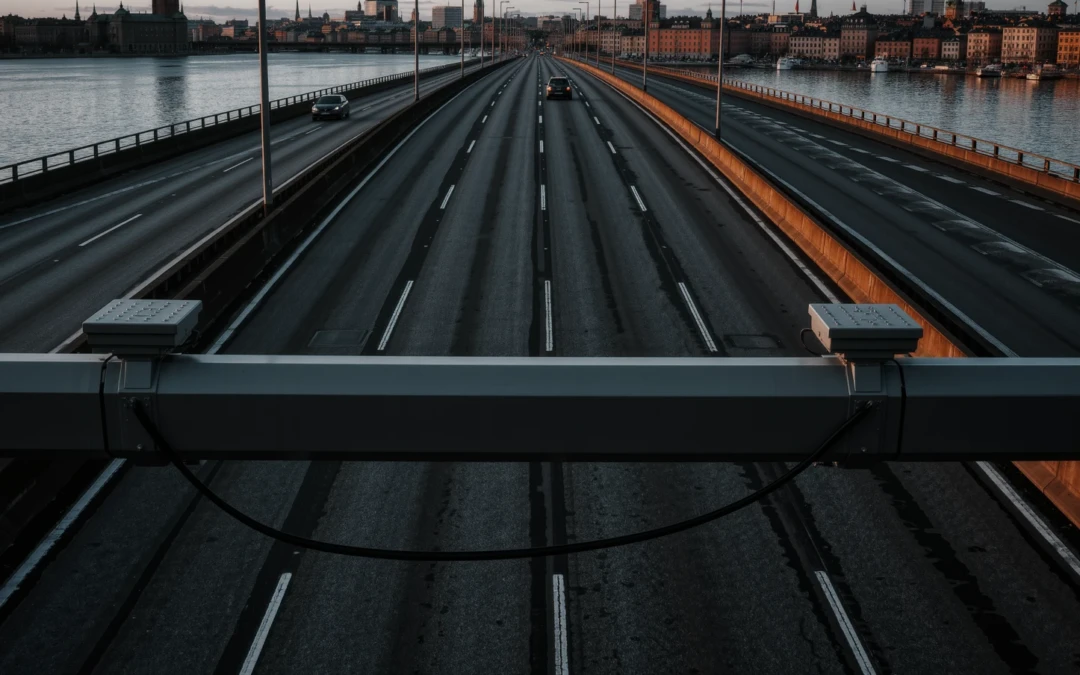
There is no toll booth on Swedish city roads. A camera reads your number plate, and the bill arrives later. That surprises visitors who never see a barrier. The figures below come from the Transport Agency’s pages, read on 13 November 2026, and from the Congestion Tax Act (2004:629, amended up to SFS 2024:519). Conversion at the Riksbank rate of 11.0628 SEK per euro on 12 November 2026.
Stockholm
Congestion tax is charged on fixed times for vehicles entering and leaving the inner city and for passing Essingeleden. The amount depends on time of day and season. High season is 1 March to the day before Midsummer Eve and 15 August to 30 November. Low season is the rest of the year, so it starts again on 1 December. The highest amount per day and vehicle is 135 SEK (about €12.20) in high season and 105 SEK (about €9.50) in low season.
- 06:00–06:29: 15 SEK in both seasons
- 06:30–06:59: 30 SEK high, 25 SEK low
- 07:00–08:29: 45 SEK high (about €4.10), 35 SEK low
- 08:30–08:59: 30 SEK high, 25 SEK low
- 09:00–09:29: 20 SEK high, 15 SEK low
- 09:30–14:59: 11 SEK in both seasons (about €1.00)
- 15:00–15:29: 20 SEK high, 15 SEK low
- 15:30–15:59: 30 SEK high, 25 SEK low
- 16:00–17:29: 45 SEK high, 35 SEK low
- 17:30–17:59: 30 SEK high, 25 SEK low
- 18:00–18:29: 20 SEK high, 15 SEK low
Essingeleden has its own table, with a top rate of 40 SEK in high season and 30 SEK in low season.
Gothenburg
The maximum per vehicle and day is 60 SEK (about €5.40). The rates are 9 SEK from 06:00 to 06:29, 16 SEK from 06:30 to 06:59, 22 SEK from 07:00 to 07:59, 16 SEK from 08:00 to 08:29, 9 SEK from 08:30 to 14:59, 16 SEK from 15:00 to 15:29, 22 SEK from 15:30 to 16:59, 16 SEK from 17:00 to 17:59, 9 SEK from 18:00 to 18:29, and nothing from 18:30 to 05:59. Under the multiple-passage rule, several passes within 60 minutes are charged once, at the highest amount.
Free days and exempt vehicles
In both cities tax is normally charged Monday to Friday. It is not charged on Saturdays, Sundays, public holidays and the day before a public holiday (Stockholm has a few exceptions to that last rule), nor in July (Stockholm charges on the first five weekdays of July). The tax applies to cars, meaning passenger cars, lorries and buses, including electric cars. Trailers and tractors are exempt. So are emergency vehicles, motorcycles, military and diplomatic vehicles, and buses of at least 14 tonnes.
Bridge fees
The Transport Agency charges infrastructure fees on three bridges, all days and all hours, including for foreign vehicles (Infrastructure Charges Act 2014:52). A car pays 4 SEK at Skurubron (about €0.36), 9 SEK at Sundsvallsbron (about €0.81) and 5 SEK at Motalabron (about €0.45). Heavy lorries pay 20 SEK at Sundsvall and 11 SEK at Motala. I did not find a vignette or time-based road charge for passenger cars on the Transport Agency’s pages.
How you pay, and how foreign cars pay
At the end of each month Transportstyrelsen sends an invoice for the previous month, with the passes and the amount per day. The vehicle owner is responsible for paying on time, even without an invoice. For foreign-registered vehicles the agency has appointed a partner, EPASS24, that identifies the owner, sends invoices and receives payments. If the payment is not booked in time, a surcharge of 500 SEK (about €45.20) per vehicle applies under the Act. If a vehicle has more than 5,000 SEK (about €452.00) in unpaid tax and surcharges and at least six months have passed, a use ban comes into force.
Rental cars: the invoice goes to the registered owner, which for a rental car is the rental company. Ask the company at pick-up how it recovers the charge from you.
Mistakes I see most often
- Thinking no barrier means no charge.
- Ignoring a letter or an email from a payment agent for a foreign car. Late payment adds 500 SEK.
- Forgetting that in and out are both counted, so the daily cap matters.
Do the math: Drive into inner Stockholm at 07:30 and out at 16:30 in high season: 45 + 45 = 90 SEK (about €8.14). Three such days are 270 SEK (about €24.40). One late invoice adds 500 SEK (about €45.20), more than five such days.
FAQ
Do electric cars pay congestion tax? Yes. The Transport Agency states that tax is charged for all cars, including all eco-friendly cars.
Does a foreign car pay? Yes. The Transport Agency says the tax covers both Swedish and foreign-registered vehicles.
Is there a charge on Saturdays? No. Congestion tax is not charged on Saturdays, Sundays and public holidays.
Where to check
transportstyrelsen.se (Trängselskatt, Infrastrukturavgift), Lag (2004:629) om trängselskatt at riksdagen.se, and the EPASS24 website for foreign cars.
Ivan’s Take
Do not treat the lack of a barrier as a free pass. The money arrives by post a month later, and for a foreign car it arrives through an agent you may not recognise. Check your payment email in the weeks after a Swedish trip. The amounts are small, the 500 SEK surcharge is not.
Sources: Transportstyrelsen – Trängselskatt i Stockholm; Transportstyrelsen – Trängselskatt i Göteborg; Transportstyrelsen – Betalning och avisering av trängselskatt; Transportstyrelsen – Infrastrukturavgift (broavgift); Lag (2004:629) om trängselskatt – riksdagen.se; Riksbank – SEK/EUR 12.11.2026.
Published:
More from this section

The AvtoGear weekly
Once a week: new tests, the best deals and one useful tip for your car. Nothing extra.
