








In short
- From 1 November to 1 April, cars must have winter equipment if there is snow, ice or black ice on the road (Rulebook Art. 113(4)).
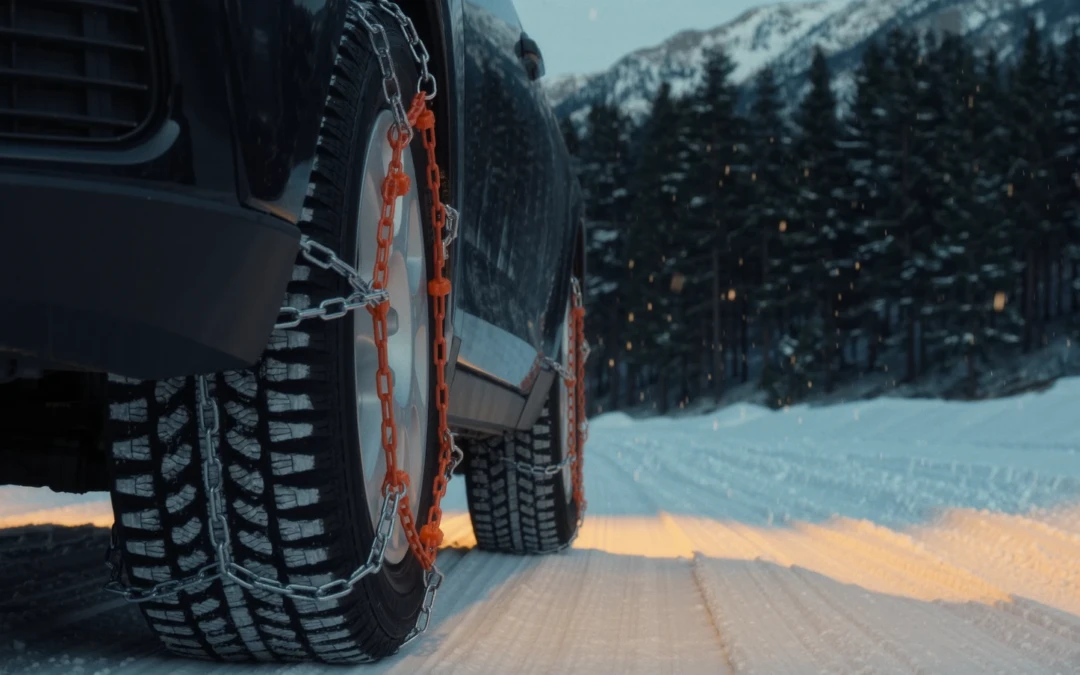
- Winter equipment for a car = winter tyres (M+S, Snow, Winter) on all four wheels with at least 4 mm tread, plus chains or other traction devices for at least two drive wheels. Studded tyres are banned.
- No or wrong winter equipment: 5,000 RSD (€42.51), ZOBSP Art. 333(1) item 77. The police can also stop you from continuing (Art. 291).
Serbia has no simple calendar rule like ‘winter tyres from November, full stop’. The date window is fixed, but the duty is tied to the weather on the road. That is exactly where drivers get it wrong, so here is the text, word for word in substance.
The rule in detail
Article 131(2) of the Law on Road Traffic Safety (ZOBSP) says the driver must have winter equipment and use it in the prescribed way. The details sit in Article 113 of the Rulebook on the classification of motor and trailer vehicles and technical conditions (Pravilnik o podeli motornih i priključnih vozila i tehničkim uslovima), last amended in Službeni glasnik 54/2026.
What counts as winter equipment. For motor vehicles except categories L, K, T, Tm, TR and C, Article 113(1) lists: winter tyres (for example M+S, Snow, Winter) on all wheels of passenger cars (M1) and light vans (N1); chains or other traction devices for at least two drive wheels; and for buses and trucks (M2, M3, N2, N3) also a shovel, except vehicles in urban public transport.
Tread and studs. When winter tyres are used as winter equipment, the tread may not be less than 4 mm (Art. 113(2)). Studded tyres may not be fitted at all (Art. 113(3)). Article 86(4) adds that tyres on the same axle must be the same make, type and kind, summer or winter, so one winter and one summer tyre on an axle is not allowed.
When. Article 113(4): from 1 November to 1 April vehicles must be fitted with winter equipment if, because of the weather, there is snow, ice or black ice on the carriageway. Outside that period you may use winter equipment, but you do not have to. In settlements, vehicles do not need to carry chains (Art. 113(5)). Chains may be fitted on a section without the ‘snow chains’ sign only when the road is covered with snow (Art. 113(6)).
What the police can do. Article 291(2) says an officer will order a driver who is on a road or section where winter equipment or chains are mandatory, and does not use them, and so endangers traffic, to put them on. If the driver does not, the officer excludes the vehicle from traffic or, where possible, sends it to a road where winter equipment is not needed (Art. 291(3)).
Fines
- Driver who does not have or does not use winter equipment as prescribed (ZOBSP Art. 131(2)): 5,000 RSD (€42.51), Art. 333(1) item 77
- If this puts another road user in direct danger or causes a crash: 6,000 to 18,000 RSD (€51.01 to €153.02), Art. 333(2)
- Ignoring the officer’s order to fit chains or winter equipment: the vehicle is excluded from traffic (Art. 291(3))
Article 335, the penalty-points list, does not attach points to the winter-equipment offence. Worn tyres are a separate matter: below the TWI marks, or 1.6 mm for cars where no marks exist (Rulebook Art. 86(6)), the car is not roadworthy.
Foreign drivers and rental cars
Article 131 speaks to every driver on a Serbian road, so a car with foreign plates is not exempt. If you cross into Serbia between November and April with summer tyres and the road is white, the duty applies to you the moment there is snow or ice on the carriageway. For a winter rental, ask for winter tyres and a set of chains that fit the car, and check the tread with a coin or gauge before you leave the lot.
Mistakes I see most often
- Reading the rule as ‘winter tyres only’. For a car it is winter tyres plus chains for two drive wheels; chains in the boot are part of the kit when the road is white.
- Winter tyres worn down to 3 mm. Legal tread for summer use, but under the 4 mm the rulebook asks for winter equipment.
- Fitting chains on a dry or wet road with no sign. Only where the road is covered with snow, or where the ‘snow chains’ sign stands.
Do the math: The math: the fine is 5,000 RSD (€42.51), and up to 18,000 RSD (€153.02) if you endanger someone. The bigger cost is the stop itself: under Art. 291 the officer can take your car out of traffic until you comply, which on a mountain pass can mean hours.
FAQ
Are winter tyres mandatory on 1 November even if the road is dry? No. Article 113(4) ties the duty to snow, ice or black ice on the carriageway during 1 November to 1 April. On a dry road you are not in breach.
Do all-season tyres count? The rulebook names winter-use tyres such as M+S, Snow and Winter. An all-season tyre marked M+S with at least 4 mm tread fits that wording.
Can I use studded tyres? No. Article 113(3) bans studded tyres on vehicles.
Ivan’s Take
I fit winter tyres before November and keep chains in the boot until April, even for city driving, because a Serbian winter trip almost always includes a pass. The fine is small; being turned back on a hill in snow is not.
Sources: Rulebook on classification of motor and trailer vehicles and technical conditions, consolidated up to Sl. glasnik RS 54/2026 (Arts 86, 113); ZOBSP, Law on Road Traffic Safety, consolidated up to Sl. glasnik RS 19/2025 (Arts 131, 291, 333, 335); National Bank of Serbia, official middle rate 12.11.2026 (1 EUR = 117.6322 RSD).
Published:
More from this section
The AvtoGear weekly
Once a week: new tests, the best deals and one useful tip for your car. Nothing extra.
