








In short
- No article of the Romanian road code bans or requires a dash cam; the mount must not restrict your view.
- Your clip can start a police case: aggressive driving reported within 30 days costs the other driver a class II fine (865 to 1,081.25 lei) and a 30-day licence suspension.
- Filming the public road makes you a data controller in the data protection authority’s view: keep clips private, do not post faces or plates.
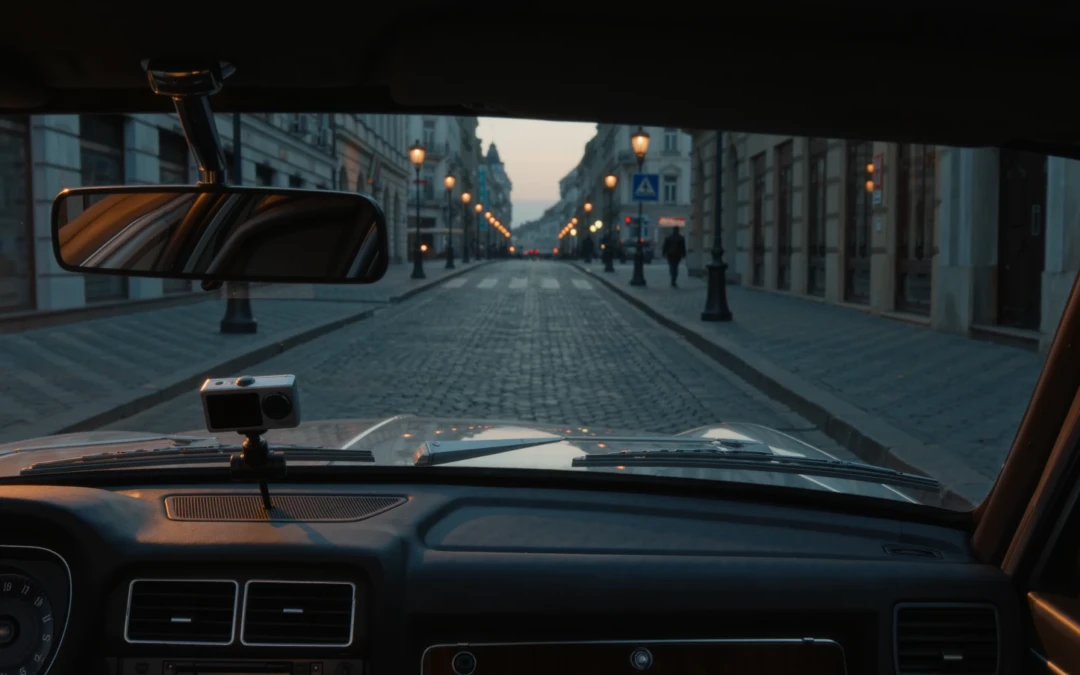
In Romania a dash cam is the cheapest witness you can buy. Before you stick one on the glass, know three things: what the road code says about the device, how police use your video, and where privacy law starts to bite.
What the road code says about the camera
I read the consolidated text of OUG 195/2002, the Romanian road code, in the form of 6 November 2026 (last amendment: Law 207/2026, Official Gazette 922 of 3 November 2026). It contains no article that bans, requires or regulates dash cams. Video appears only in two places: the recording of driving exams and the complaint procedure explained below. So owning and running a dash cam is not an offence.
Where you put it is another matter. Art. 102(1) point 36 punishes accessories fixed on the windscreen, rear window or side windows that reduce visibility below the legal limit or weaken lights and signalling. That sits in class IV, the second most severe class for individuals. Art. 112(1)(l) lets police retain the registration certificate for such accessories, and you receive a replacement paper valid for 15 days (art. 112(2)).
Your footage can start a police case
Art. 109^3 allows traffic police to sanction aggressive driving after a complaint from a road user who saw it directly and by chance, and recorded it on video or audio-video. Art. 54^1(2) lists nine aggressive manoeuvres, among them weaving between lanes to pass a queue, very close following or sudden braking meant to intimidate, repeated horn or flashing to force a driver out of the lane, reversing to intimidate, intentional controlled skids and repeated engine revving that disturbs people near the road.
- The complaint goes through the police online platform and must carry your name, personal number, phone, postal address, a statement on your own responsibility, date, time, place and your signature.
- The video must contain a frame extract, date and time, the place, the vehicle with its plate number and the road signs of that stretch.
- It must reach police within 30 days; later complaints are closed without action.
- It is not “by chance” if you report more than one possible offence about the same car in 24 hours or more than three in 15 days. For the same place the limits are more than three in 24 hours or more than seven in 15 days.
- Police keep complaint and footage for one year and then destroy them, unless they are used in court. Your personal data stays confidential.
Fines
Romanian fines are counted in penalty points. Under art. 98(2) one point is 5% of the gross national minimum wage. Government Decision 146/2026 sets that wage at 4,325 lei from 1 July 2026, so one point is 216.25 lei. The National Bank of Romania rate on 12 November 2026 is 5.3459 lei per euro, so one point is about 40.45 euro.
- Aggressive driving caught on camera (art. 100(3)(i)), class II: 4 to 5 points, that is 865 to 1,081.25 lei (about 162 to 202 euro), plus suspension of the right to drive for 30 days.
- Accessory restricting visibility (art. 102(1) pt. 36), class IV: 9 to 20 points, that is 1,946.25 to 4,325 lei (about 364 to 809 euro).
Privacy: the part people forget
The traffic law is silent on privacy, but data protection law is not. After the EU Court of Justice ruling C-212/13 of 11 December 2014, the Romanian authority ANSPDCP stated that a private person whose camera also films a public space is no longer covered by the personal-use exemption. That person becomes a data controller and must follow the rules, and the authority urged people to aim cameras so they avoid watching public space. That communique cites the old Law 677/2001; the principle is now handled under the GDPR, which ANSPDCP applies since 25 May 2018. I did not find an ANSPDCP page written specially for car cameras, and I found no fixed fine for posting clips, so I will not invent one.
My practical reading: keep clips for yourself, your insurer and the police, and do not publish faces or readable plates.
Visitors and rental cars
The fine articles above punish the individual who commits the act and make no distinction by plate nationality. If you bring your own camera in a rental, the same mounting rule applies to you.
Mistakes I see most often
- A big suction mount in the middle of the windscreen, in the wiped area, where it blocks the view.
- Posting a road-rage clip with plates and faces on social media.
- Sending a complaint after 30 days, or filing several complaints about the same car or place and getting them all closed.
Do the math: The math: a camera mount that blocks your view costs at least 1,946.25 lei (about 364 euro). A complaint sent on day 31 costs nothing but is closed unread. A clip posted online has no fixed price in the sources I read, so the safe price is zero posts.
FAQ
Is a dash cam legal in Romania? Yes. The road code contains no ban or duty. Mount it so it does not restrict visibility.
Can I send my video to the police? Yes, for aggressive driving, within 30 days, through the police platform, with the data and frames listed in art. 109^3.
Can I post my clip online? It is risky. Under the authority’s logic you are a data controller once you film public space. I found no official dash cam guidance, so ask ANSPDCP before you publish.
Where to check
legislatie.just.ro for OUG 195/2002 (art. 54^1, 98, 100, 102, 109^3, 112) and HG 146/2026; dataprotection.ro for ANSPDCP; bnr.ro for the exchange rate.
Ivan’s Take
Buy one, hide it behind the mirror and keep the clips private. It protects your wallet in an accident dispute. Posting the video online is where an honest driver turns into a data problem.
Sources: OUG 195/2002 (consolidated 06.11.2026, art. 54^1, 98, 102, 109^3, 112); HG 146/2026 (minimum wage 4,325 lei); ANSPDCP: CJEU C-212/13 communique; BNR exchange rate.
Published:
More from this section
The AvtoGear weekly
Once a week: new tests, the best deals and one useful tip for your car. Nothing extra.
