








In short
- Since 10 September 2026 the Norwegian rule on loads reads that cargo must not fall or run off the vehicle or drag on the road (BRUK § 3-2 nr 3 b).
- Since 18 September 2026 driving with run-off from the load (avrenning) carries a new administrative fee: NOK 2,000 (≈ €189) for the driver and NOK 20,000 (≈ €1,891) for the company (GEB § 10b). The fee item names run-off only, not cargo that falls off.
- Older load rules still apply: clear view, lights and plates uncovered, at least 20 % of the vehicle’s actual weight on the steered wheels. Lights covered by load already cost NOK 2,000.
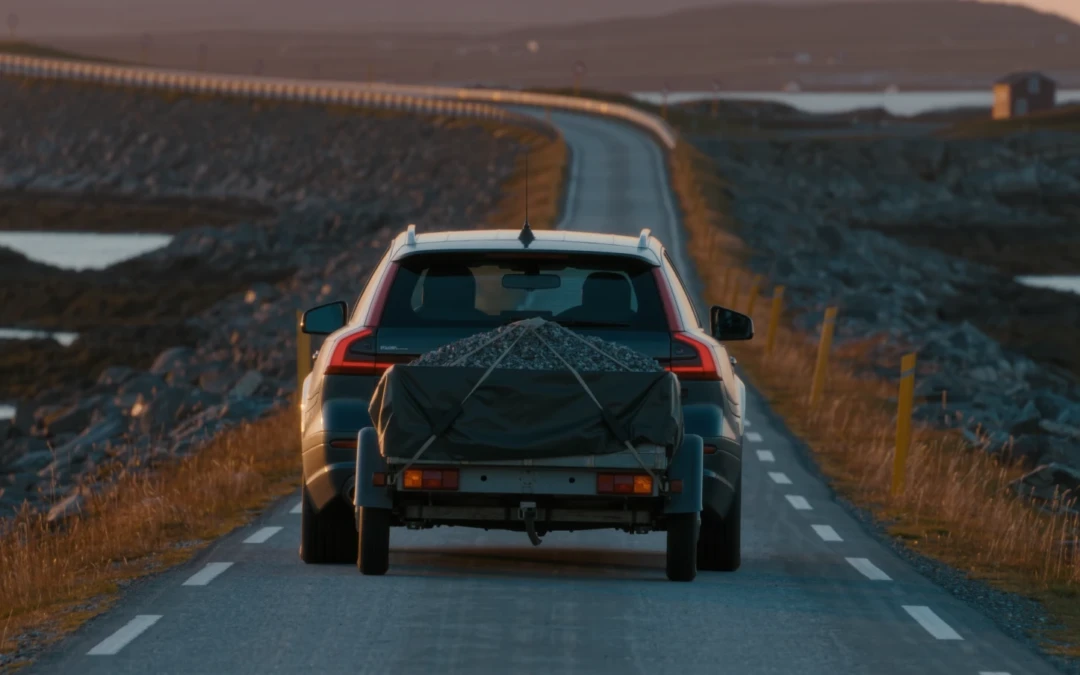
Gravel on a trailer, a bag on the roof, a sheet that comes loose on the motorway. Norway has reworded the load rule that covers all of this, and it has attached a fixed fee to one part of it: run-off from the load. If you drive anything with a load in Norway, this is the 2026 change to know.
Two changes, two dates
10 September 2026: the regulation on the use of vehicles (Forskrift om bruk av kjøretøy, FOR-1990-01-25-92) was amended by FOR-2026-09-10-1767. In § 3-2 nr 3 b the load must now be secured so that it does not “fall or run off the vehicle or drag on the road” (my translation of “falle eller renne av kjøretøyet eller slepe på vegen”).
18 September 2026: FOR-2026-09-18-1814 added § 10b to the fee regulation (FOR-2021-03-26-963). The new section is headed “Avrenning” (run-off) and covers driving with run-off from the load in breach of § 3-2 nr 3 b. I read both texts on Lovdata’s official public data service on 18 November 2026. The regulation does not define the word, and I do not add a definition. Cargo that falls off or drags is still a breach of § 3-2, but § 10b names only run-off, so I give no fixed fee for a fallen load.
The fees
- Run-off from load, driver: NOK 2,000 (≈ €189 at the Norges Bank rate of 17.11.2026).
- Run-off from load, company: NOK 20,000 (≈ €1,891).
- Front main lights, all rear lights or all brake lights covered by load (§ 10 c): NOK 2,000, listed as a separate item.
- Vehicle up to 3,500 kg overloaded by more than 30 % or 500 kg (§ 10 h): NOK 3,000 (≈ €284).
- Payment: within 3 weeks, otherwise late-payment interest. The fee can be imposed from age 15 (§ 2).
What the load rules already required
Section 3-2 of the use regulation is wider than the new wording. The load must not block the driver’s view or the ability to manoeuvre, and it must not cover lights or number plates. At least 20 % of the actual weight must rest on the steered wheels. The load must be secured so it cannot fall off, run off or drag, disturb other road users, or create dust or noise. Chains, ropes and tarpaulins are named as means of securing. The rules for overhang beyond the vehicle width are a separate subject, and I leave them out here.
For vehicles over 3,500 kg there is a further change: from 1 June 2026 the transport company must make documentation on load securing available to the driver for certain high-risk loads (§ 3-2a, FOR-2026-03-20-442 and FOR-2026-05-05-742). This concerns trucks, not a family car.
Foreign drivers and rental cars
§ 10b names the driver (fører) and the company (foretak). The text sets no limit to Norwegian-registered vehicles. How a fee reaches a visitor after the trip I did not verify. If you rent a trailer or a roof box in Norway, you are the driver the text names.
Mistakes I see most often
- An open trailer with loose gravel, soil or garden waste and no cover. This is the situation the reworded § 3-2 nr 3 b is about.
- Boards, bags or bikes on the roof with one strap, or none. The regulation names ropes and tarpaulins for a reason.
- Forgetting the second line of the fee. For run-off from a company vehicle, § 10b allows NOK 20,000 for the company as well as NOK 2,000 for the driver.
Do the math: run-off from the load costs the driver NOK 2,000 (≈ €189), and the company can be charged ten times that, NOK 20,000 (≈ €1,891). Straps and a cover for a trailer cost a fraction of a single fee, and they also keep the load on your own property.
FAQ
Is the fee already in force? Yes. § 10b came into force on 18 September 2026, and the reworded load rule on 10 September 2026.
Does it apply to private cars? The fee names the driver and I read no limit to professional drivers, so a private driver is not excluded by the text.
What if a fallen load injures someone? The fee is only the administrative part. Other consequences, such as criminal or civil liability, are outside the texts I read, and I make no statement on them.
Ivan’s Take
A load that stays on is the cheapest thing you can buy. A loose load is a securing problem, and the rule is written that way. Tie it, cover it, and check it again after the first 20 minutes.
Sources: Lovdata – Forskrift om bruk av kjøretøy (FOR-1990-01-25-92) § 3-2; Lovdata – Forskrift om gebyr for visse overtredelser av vegtrafikklovgivningen (FOR-2021-03-26-963) § 10b; Norges Bank – EUR/NOK (17.11.2026).
Published:
More from this section
The AvtoGear weekly
Once a week: new tests, the best deals and one useful tip for your car. Nothing extra.
