








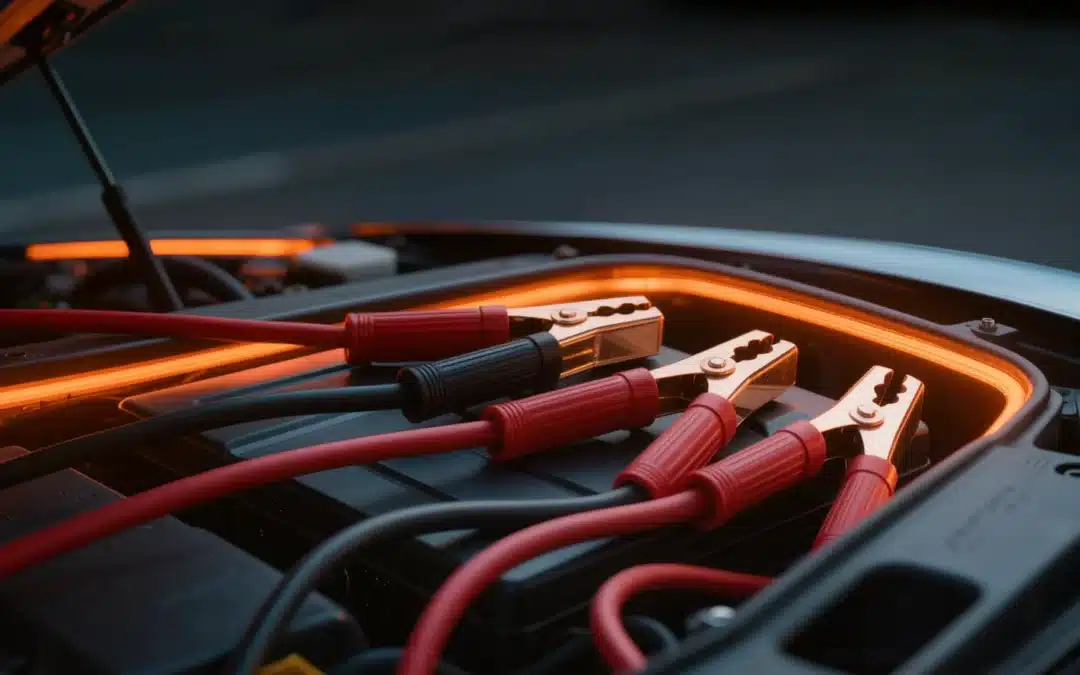
In short
- A flat battery is the most common breakdown on the first cold days. Jump leads cost €15 to €50 and live in the boot for years.
- ADAC order: red to the dead car’s plus, then the donor’s plus. Black to the donor’s minus, then to an earth point on the dead car, never its battery.
- Buy leads to DIN 72553 or ISO 6722, at least 25 mm² and at least 2 metres long.
Cold morning, you turn the key, the engine coughs once and stops. The battery is flat. You can wait for roadside help, or a neighbour helps you in five minutes. With the right cables and the right order. Get the order wrong and you risk sparks, a damaged battery sensor or an expensive control unit.
The short answer: Red clamp to the dead car's plus, then the donor's plus; black to the donor's minus, then a bare metal earth point on the dead car, never its battery.
Why batteries die in winter
ADAC names age as the most common cause. An old battery loses capacity and gives up on the first cold days. Long standstills and short trips do the rest, because the alternator never gets time to recharge it.
Warning signs: the engine turns slowly, or the lights dip hard when you start. Then have the battery tested before it leaves you standing.
What to look for in jump leads
- Standard: DIN 72553 or ISO 6722. It covers cross-section, length, clamp force and insulation.
- Cross-section: ADAC says at least 25 mm². Diesels need strong cables because of high starting currents.
- Copper or aluminium: aluminium conducts worse. Auto Zeitung says 25 mm² copper equals about 40 mm² aluminium.
- Length: at least 2 metres (ADAC). 3 to 3.5 metres is common and easier when the cars cannot park nose to nose.
- Clamps: fully insulated, only the contact faces bare. Toothed jaws and strong springs so they do not slip.
- Cold flexibility: a cable that goes stiff at minus 10 °C is a fight under the bonnet.
Prices? Auto Zeitung puts jump leads at €15 to €50. The cheap end is often thin. An AEG SK 16 set with 16 mm² aluminium cost €16.99 at the time of their review and is meant for small petrol engines. An Autonik DIN set with 25 mm² aluminium-copper and surge protection cost €38.41. For a diesel or anything above two litres, buy the thicker one.
Step by step: the ADAC order
- 1. On a busy road: warning triangle out, vest on.
- 2. Red cable to the plus terminal of the dead car. Other end to the plus of the donor car.
- 3. Black cable to the minus of the donor car (or its marked earth point).
- 4. Other black end to the marked earth point of the dead car or bare metal on the engine block. Never on the dead car’s battery: sparks.
- 5. Start the donor car. Wait a few minutes.
- 6. Start the dead car. If it fails, wait a minute and retry. After the third failed try, call for help.
- 7. Once it runs, switch on big consumers in the dead car (fan, rear window heater, lights) to soak up voltage spikes.
- 8. Remove the black cable first (dead car, then donor), then the red one.
- 9. Switch the consumers off and drive a longer stretch, or charge the battery overnight with a charger.
Start-stop cars, diesels and EVs
Start-stop cars have a battery sensor on the minus pole. Clamp black there and you can damage it. Always use the earth point in the engine bay. Your owner’s manual shows it.
EVs also have a 12-volt battery. They can usually receive a jump start. Giving one is mostly not allowed by the manufacturers, because the small 12V battery and the electronics can be damaged. Check the manual before your EV helps anyone.
Mistakes to avoid
- Mixing up plus and minus. If you cannot find the markings, do not guess. Look in the manual or call a pro.
- Black clamp on the dead battery. That is where hydrogen gas and sparks meet.
- Thin cables on a diesel. The car does not start and the clamps get hot.
- Cranking again and again. More than three failed tries can cause damage.
- Leaving the old battery as it is. If it happens twice, test or replace it.
Do the math: A decent 25 mm² set costs about €30 to €40 and lasts ten winters or more. That is €3 to €4 per winter. The alternative is waiting for roadside help in the cold, or paying for a callout if you are not a club member. One avoided wait pays for the cable.
FAQ
Red or black first? Red first. Dead car plus, then donor plus. Then black on the donor minus and finally on an earth point of the dead car.
Which cable size do I need? ADAC recommends at least 25 mm² and a DIN 72553 or ISO 6722 cable. Aluminium cables need to be thicker than copper.
Can an electric car jump-start my petrol car? Usually not. Most manufacturers forbid it. Receiving a jump start is mostly fine. The manual decides.
Ivan’s Take
Every car I own has a set of jump leads in the boot, and I buy the thick 25 mm² ones. The €20 difference to a thin set is the difference between a car that starts and one that does not. If your battery is old and the engine already sounds tired, have it tested now, not in January.
Sources: ADAC Starthilfe; Auto Zeitung.
Published:
More from this section


The AvtoGear weekly
Once a week: new tests, the best deals and one useful tip for your car. Nothing extra.
