








In short
- Article 72 of the Italian Highway Code makes the warning triangle part of every car’s compulsory equipment. Without it: €87 to €344.
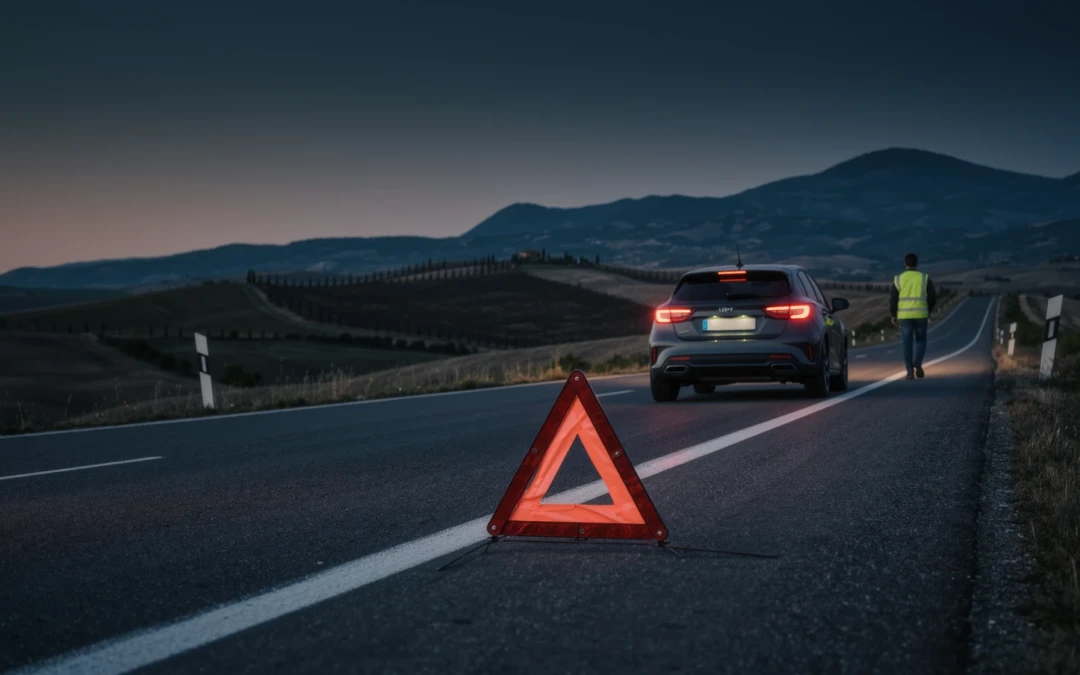
- Outside built-up areas the triangle goes at least 50 m behind the stopped car and must be visible from 100 m (Regulation, Art. 357).
- Stepping out of the car on the carriageway, hard shoulder or lay-by without a high-visibility vest or braces costs €42 to €173 (Art. 162).
Italy’s list of compulsory equipment is short, but it is enforced, and the rules on how to use it are precise to the metre. A breakdown on the autostrada at night is exactly when a forgotten triangle or vest becomes a fine on top of a tow. Here is what the law requires and where each number comes from.
What a car must be equipped with
Article 72 of the Codice della Strada (Legislative Decree 285/1992, consolidated text on Normattiva, last update published on 24 April 2026) lists the devices a motor vehicle must have. Paragraph 1: lighting and signalling devices, silencer and exhaust for combustion engines, horn, mirrors and tyres or equivalent systems. Paragraph 2 adds for cars: a reverse gear (above 0.35 t), restraint devices where the car has the anchorage points from the factory, the warning triangle described in Article 162, and an odometer.
Neither a first-aid kit nor a fire extinguisher appears among the devices listed in Article 72(1) and (2) for cars. I am not going to tell you to carry things the law does not name; I am telling you what costs money if it is missing.
The warning triangle: when and where
Article 162(1): outside built-up areas, a vehicle stopped on the carriageway must be signalled with the triangle at night when its rear position lights or hazard lights are missing or not working, and at any time of day when following drivers cannot see it from a sufficient distance. Bicycles, two-wheel mopeds and motorcycles are excluded.
The implementing Regulation (Presidential Decree 495/1992, Art. 357) gives the numbers. By day the triangle is needed when the vehicle or a fallen load is not clearly visible from 100 m; at night when the lights are missing or insufficient, and always when the load has fallen. Place it on the road surface behind the vehicle, at least 50 m away, so that it is fully visible from 100 m. It goes in the lane occupied by the vehicle, at least 1 m from the outer edge of the carriageway, reflective face towards traffic. If a junction is closer than 50 m, put it where it is best seen. Remove it when you leave.
The triangle must be an approved model with the approval marks (Art. 162(3)); triangles approved under UN ECE Regulation 27 are accepted (Regulation, Art. 358(4)). If you have none, the law still requires you to signal the obstacle effectively in another way (Art. 162(4)).
The reflective vest: the rule is about stepping out
Article 162(4-ter) has applied since 1 April 2004: in the situations of paragraph 1, the driver may not get out of the vehicle and move on the road without wearing a high-visibility reflective vest or braces. The ban also applies when the car is in the emergency lane or a lay-by. Article 162(4-bis) adds that reflective personal protective devices must be used while placing the triangle.
Fines
- Car without the warning triangle or with a non-conforming device required by Article 72: €87 to €344 (Art. 72(13)).
- Not signalling the stopped vehicle as required, or stepping out without the vest or braces: €42 to €173 (Art. 162(5)).
Foreign drivers and rental cars
Article 162 does not distinguish by the country where the car is registered: it applies to the driver of the stopped vehicle on an Italian road. A rental car should come with a triangle; the vest rule applies to you as the person getting out, so check before you leave the desk.
Mistakes I see most often
- The vest in the boot. To reach it you already walk on the road. Keep it in the cabin.
- The triangle five metres behind the car. The minimum is 50 m, and it must be visible from 100 m.
- Leaving the triangle on the road after the breakdown is cleared. The Regulation says remove it.
Do the math: No triangle at a check: minimum €87, or €60.90 if paid within 5 days (Art. 202(1)). No vest when you step out: minimum €42, or €29.40 within 5 days. Together that is €90.30 at best and up to €517 at the top of both ranges.
FAQ
Do I need one vest per passenger? The rule in Article 162(4-ter) is addressed to the driver who gets out in the listed situations. It does not set a number of vests per car.
Is the triangle needed in town? The signalling duty of Article 162(1) applies outside built-up areas. The triangle is still compulsory equipment under Article 72(2)(b) wherever you drive.
Does a triangle bought in another EU country count? Triangles approved under UN ECE Regulation 27 are admissible (Regulation, Art. 358(4)). Check the approval mark on yours.
Where to check
Normattiva (normattiva.it): Codice della Strada Articles 72, 162 and 202; Regolamento di esecuzione (DPR 495/1992) Articles 357 and 358.
Ivan’s Take
Triangle under the boot floor, vest in the door pocket. That is my setup and it costs less than one minimum fine. On an Italian motorway at night the 50 metres are not bureaucracy; they are the distance a truck needs to see you.
Sources: Normattiva – Codice della Strada, art. 72 (D.Lgs. 285/1992); Normattiva – Codice della Strada, art. 162; Normattiva – Codice della Strada, art. 202; Normattiva – Regolamento CdS (DPR 495/1992), art. 357; Normattiva – Regolamento CdS (DPR 495/1992), art. 358.
Published:
More from this section

The AvtoGear weekly
Once a week: new tests, the best deals and one useful tip for your car. Nothing extra.
