








In short
- Italy’s general limits are 130 km/h on motorways, 110 km/h on main extra-urban roads, 90 km/h on other roads outside towns and 50 km/h in towns (art. 142 of the Codice della Strada).
- In rain or snow the limit drops to 110 km/h on motorways and 90 km/h on main extra-urban roads. New drivers are capped at 100 and 90 km/h for three years.
- Fines run from €42 to €3,382. More than 40 km/h over the limit also costs 6 or 10 points and your licence for 1 to 12 months.
Italy measures speed with fixed cameras, mobile units and average-speed sections. The law accepts all of it as evidence, plus tachograph records and motorway toll documents (art. 142, para. 6). One fast stretch on holiday can cost more than the whole trip’s fuel. Here is exactly what the Codice della Strada says, in the version on Normattiva updated to 24 April 2026.
The rule in detail
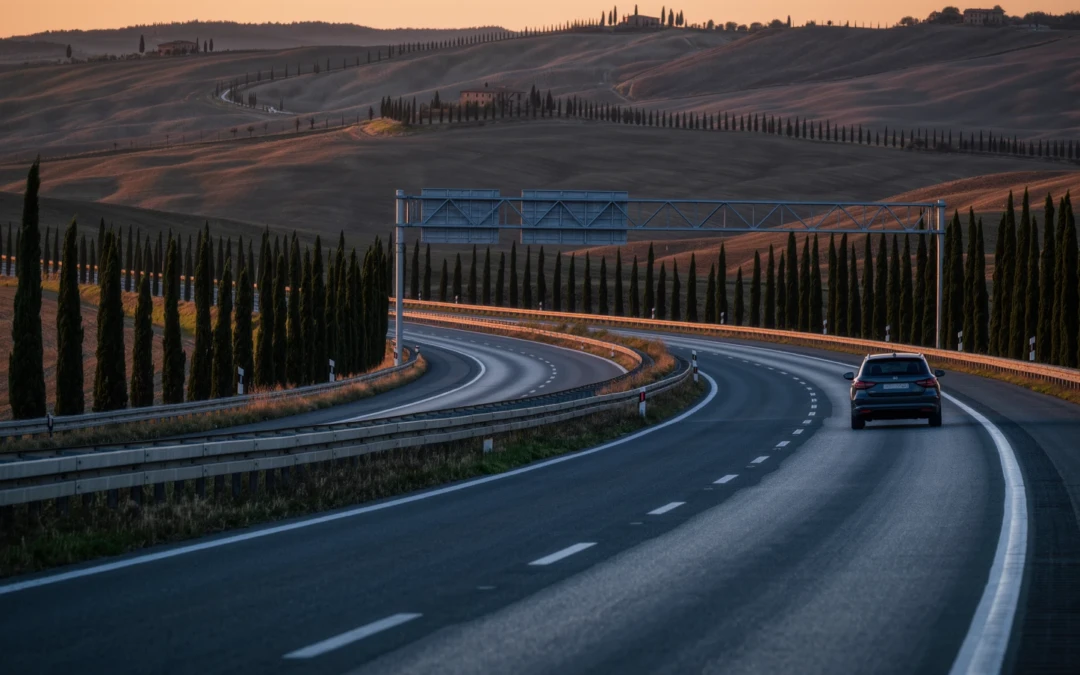
Article 142 sets the maximum speeds for cars: 130 km/h on motorways (autostrade), 110 km/h on main extra-urban roads, 90 km/h on secondary and local extra-urban roads and 50 km/h in built-up areas. On suitable urban roads the town may raise the limit to 70 km/h, but only with signs.
On motorways with three lanes plus an emergency lane in each direction and approved average-speed equipment, the operator may raise the limit up to 150 km/h. Again, only where signs say so. No sign, no 150.
Rain, snow or any other precipitation changes the numbers automatically: 110 km/h on motorways and 90 km/h on main extra-urban roads. No extra sign is needed. Many foreign drivers miss this one.
New drivers. For the first three years after passing for licence categories A2, A, B1 or B, the maximum is 100 km/h on motorways and 90 km/h on main extra-urban roads (art. 117, para. 2). For holders of an Italian licence the fine is €165 to €660 plus a suspension of 2 to 8 months (art. 117, para. 5).
Speed checkpoints must be signalled in advance and clearly visible (art. 142, para. 6-bis). Since the reform in force from 14 December 2024 there is also a rule for several cameras in a row: if the same vehicle commits several speeding offences on roads of the same authority within one hour, you get the penalty for the most serious one increased by one third, when this is more favourable than adding them all up (para. 6-ter).
Fines, points and suspensions
- Up to 10 km/h over: €42–173, no points (art. 142, para. 7).
- 10–40 km/h over: €173–694, 3 points (para. 8).
- 10–40 km/h over inside a built-up area, at least twice in one year: €220–880 and suspension of 15–30 days (para. 8).
- 40–60 km/h over: €543–2,170, 6 points, suspension 1–3 months (para. 9).
- More than 60 km/h over: €845–3,382, 10 points, suspension 6–12 months (para. 9-bis).
- A second 40–60 offence within two years: suspension 8–18 months. A second offence of more than 60 km/h within two years: the licence is revoked (para. 12).
Three more rules change the final bill. Between 22:00 and 07:00 speeding fines are increased by one third (art. 195, para. 2-bis). If you pay within 5 days, the minimum fine is reduced by 30% – but not for offences that carry a licence suspension (art. 202, para. 1). Otherwise you pay the minimum within 60 days. And for drivers in their first three years (licence issued after 1 October 2003, no earlier B licence), the points are doubled (note to the points table of art. 126-bis).
Foreign drivers and rental cars
With a foreign-registered car you can pay the reduced amount on the spot to the officer (art. 207, para. 1). If you do not, you must leave a deposit. For cars registered in the EU or EEA the deposit equals the reduced payment of art. 202; for other countries it is half of the maximum fine. No payment means the car is detained until you pay, for up to 60 days, with custody costs on you (para. 2–3).
With a rental car, the fine goes to the owner – the rental company. The owner must give the police the driver’s details within 60 days of notification, or pay €291–1,166 itself (art. 126-bis, para. 2). In practice the fine follows you as the driver.
Mistakes I see most often
- Driving 130 in the rain. The legal limit is already 110 km/h, with no sign telling you.
- Treating ‘just 10 over’ as free. The fine starts at €42 from the first km/h over the limit.
- Forgetting the night surcharge. The same offence at 23:00 costs one third more than at 21:00.
Do the math: The math: 50 km/h over on a 130 km/h motorway at 23:00. Band 40–60 km/h: minimum €543 + one third for night = €724, 6 points, 1–3 months without a licence, and no 5-day discount. Time saved on 100 km at 180 instead of 130 km/h: about 13 minutes. That is roughly €56 per minute.
FAQ
Is 150 km/h allowed on Italian motorways? Only on three-lane motorways with an emergency lane and average-speed equipment, and only where the operator has put up the signs. Everywhere else the maximum is 130 km/h.
Do I get the 30% discount for speeding? Yes for up to 40 km/h over, if you pay within 5 days. No for 40 km/h and more, because those offences carry a licence suspension.
What if two cameras catch me within an hour? If both are on roads of the same authority, the law applies the penalty for the most serious offence increased by one third, when that is more favourable than separate fines (art. 142, para. 6-ter).
Where to check
Normattiva, the official database of Italian law: Codice della Strada (D.Lgs. 285/1992), articles 117, 142, 195, 202, 207 and the points table of art. 126-bis, consolidated version updated to 24 April 2026.
Ivan’s Take
I drive in Italy with cruise control set to the limit and the rain rule in my head. 110 in the wet is not a suggestion, it is the law. The fines are not the worst part – a one-month suspension on holiday ends the trip.
Sources: Normattiva – Codice della Strada, art. 142 (Limiti di velocità); Normattiva – Codice della Strada, art. 117 (neopatentati); Normattiva – Codice della Strada, art. 195 and 202 (night surcharge, reduced payment); Normattiva – Codice della Strada, art. 207 (foreign vehicles); Normattiva – Codice della Strada, art. 126-bis and points table.
Published:
More from this section
The AvtoGear weekly
Once a week: new tests, the best deals and one useful tip for your car. Nothing extra.
