








In short
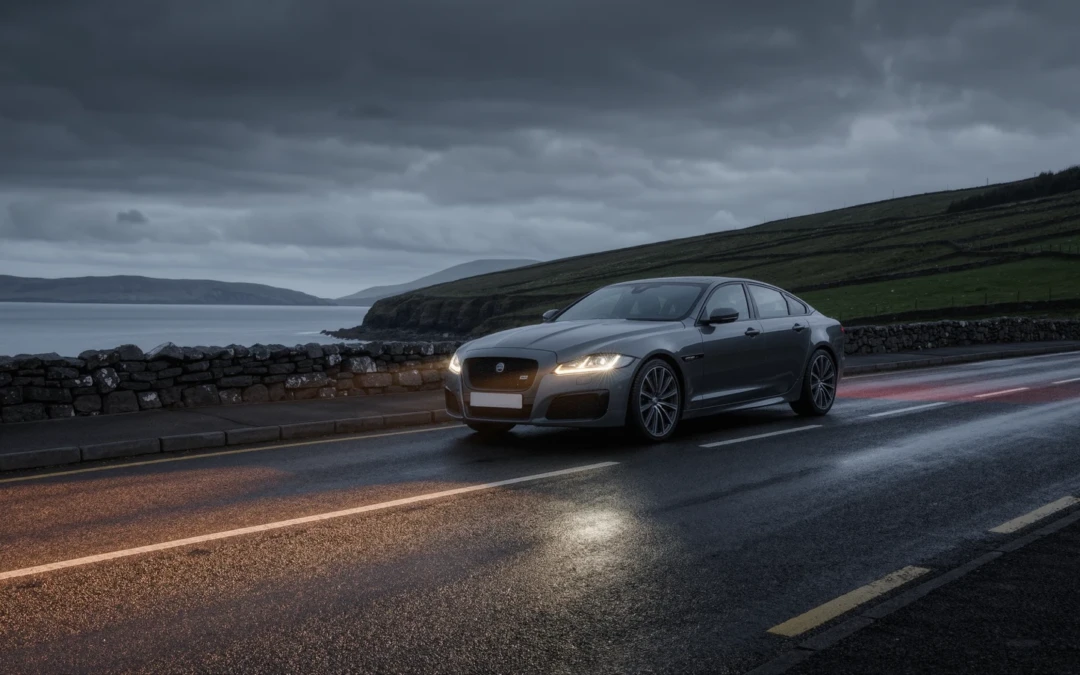
- Headlights must be on while driving during lighting-up hours: from half an hour after sunset to half an hour before sunrise.
- Dipped beam is compulsory in towns and on lit roads, when meeting traffic, when following another car, and in fog or falling snow.
- No working lights: €60 fixed charge and 1 penalty point. Not using them is a court offence: up to €1,000 for a first offence.
Irish lighting law dates from 1963 and still applies. It is more precise than most drivers think. Here is when your lights must be on, when you must dip, and what it costs to get it wrong.
When lights must be on
The rules are in the Road Traffic (Lighting of Vehicles) Regulations 1963 (S.I. No. 189 of 1963). The Regulations define “lighting-up hours” as the period from half an hour after sunset to half an hour before sunrise.
- Side and rear lamps: must be lit at all times while the vehicle is used in a public place during lighting-up hours (article 20(1)(a)).
- Headlamps: must be lit while the vehicle is driven in a public place during lighting-up hours (article 20(1)(b)).
- Daytime with poor visibility: if failing light or weather reduces visibility to night-time level, side and rear lamps must be lit. If it is bad enough that headlamps are needed for safe driving, they must be on too (article 20(2)).
There are three exceptions for headlamps: a reasonable period just after lighting-up hours start or before they end if visibility is adequate; while stopped in traffic; and on a road with a speed limit and continuous street lighting at least as bright as dipped headlamps, in good visibility.
In the 1963 Regulations I read, there is no general rule that headlights must be on in normal daylight. Many cars run daytime running lights anyway. They do not replace headlamps and rear lamps at night or in poor visibility.
When you must dip
Article 49(2) is the key one. With headlamps lit, you must dip:
- in good time when you are about to pass an oncoming vehicle;
- when travelling close behind another vehicle, except while overtaking it;
- on any road with a speed limit under sections 45 or 46 of the 1961 Act (in practice, roads with posted limits);
- on roads with no speed limit when visibility is good and the road is continuously lit;
- in dense fog or falling snow;
- in reasonably good visibility at the start and end of lighting-up hours.
The flip side: on a vehicle capable of more than 24 mph, you must not dip if dipping would leave you without enough view of the road for your speed (article 49(2)(c)). Full beam on a dark country road is legal and expected, until someone comes the other way.
Fog lamps, reversing lamps and indicators
- Front fog lamps may be used only in fog or while snow is falling (article 49(8)). Two correctly placed fog lamps can count as headlamps in those conditions (article 20(1)(c)).
- Reversing lamps only while reversing, never to inconvenience other traffic (article 49(4)).
- Indicators only to show a real change of direction (article 49(3)).
Parking at night
A parked car needs its lamps lit during lighting-up hours, with exceptions. A car with up to 8 passenger seats, properly parked in a street and parallel to the road, does not need them if the street lighting makes it clearly visible, or if it shows one side lamp and one rear lamp on the side nearest the centre of the street, or a parking lamp (article 50(3)). A parked car must not show other light to the front, for example headlamps (article 49(1)).
Fines and penalty points
- Using a vehicle not equipped with the required lamps (article 9(1)): €60 fixed charge (S.I. No. 227 of 2024, Schedule 6), 1 penalty point on payment, 3 on conviction (Road Traffic Act 2002, First Schedule, Part 3).
- Not using lights or not dipping (articles 20 and 49): this is not on the fixed charge list. It is an offence under section 11 of the Road Traffic Act 1961 and goes to court. With no specific penalty set, section 102 applies: up to €1,000 for a first offence and up to €2,000 for a second.
A blown headlamp bulb is the classic “lamps not as required” case. Cheap to fix, annoying to pay for.
Foreign drivers and rental cars
These rules apply to every vehicle used in a public place in Ireland, whatever its registration. Ireland drives on the left. If your car is set up for right-hand traffic, check the manual for the left-hand traffic headlamp setting before you go: article 49 is about not causing undue inconvenience to other traffic.
Mistakes I see most often
- Driving at dusk on DRLs only. The rear of many cars stays dark, and headlamps are required half an hour after sunset.
- Leaving front fog lamps on in rain. The law allows them only in fog or falling snow.
- Full beam in town. On any road with a speed limit, lit headlamps must be dipped.
Do the math: Missing bulb: €60 and 1 point. A replacement bulb usually costs far less than the fixed charge. Not using lights at night: a court case and up to €1,000. The switch costs nothing.
FAQ
Do I need headlights on during the day in Ireland? Not in normal daylight under the 1963 Regulations. You must use them in the day when failing light or weather makes them necessary for safe driving.
Can I use full beam on Irish roads? Yes, outside speed-limited and lit roads, as long as you dip for oncoming traffic and when following another vehicle.
Do I need lights when parked on a street at night? Not if the street lighting makes your car clearly visible and you are properly parked, or if you show a side and rear lamp on the traffic side or a parking lamp.
Ivan’s Take
A 1963 law with feet and miles per hour still sets the rules, and it works. The logic is simple: be seen, do not dazzle. Check your bulbs every month in winter, it takes two minutes.
Sources: S.I. No. 189/1963 Road Traffic (Lighting of Vehicles) Regulations, arts. 9, 20, 49, 50; S.I. No. 227/2024 Fixed Charge Offences Regulations, Schedule 6; Road Traffic Act 2002 (revised), First Schedule Part 3; Road Traffic Act 1961 (revised), ss. 11 and 102.
Published:
More from this section
The AvtoGear weekly
Once a week: new tests, the best deals and one useful tip for your car. Nothing extra.
