








In short
- In Ireland you may not hold a mobile phone while driving. Holding includes cradling it against your shoulder, not only in your hand.
- The fixed charge is €120 with 3 penalty points, in force since 20 May 2024. In court it is 5 points and a fine of up to €2,000.
- Texting or reading messages is banned even when the phone sits in a holder. A hands-free device is allowed.
The phone rule in Ireland is short, but two details catch drivers out. The law counts a phone wedged against your shoulder as held, and a separate rule bans texting even when you do not hold the phone at all.
The rule in detail
Section 3(1) of the Road Traffic Act 2006 says a person shall not hold a mobile phone while driving a mechanically propelled vehicle in a public place. Since 20 May 2024 the same applies to powered personal transporters such as e-scooters (Road Traffic and Roads Act 2023, section 34).
The definitions in section 3(9) matter:
- “Hold” means holding the phone by hand or supporting or cradling it with another part of the body.
- “Mobile phone” is a portable device for calls or interactive communication: messages, images, internet. For the holding rule it does not include a hands-free device.
- A two-way radio is not a mobile phone under this section.
The second rule is the Road Traffic Act 2006 (Restriction on Use of Mobile Phones) Regulations 2014 (S.I. 178/2014), in force since 1 May 2014. While driving in a public place you may not send or read a text message from a mobile phone. Text message includes SMS, MMS and email. Composing counts as sending, but anything done without touching the phone, such as voice dictation, does not. Opening a message other than by voice counts as reading.
Exceptions
- Gardaí, ambulance and fire brigade members acting in the course of their duties (section 3(2)).
- A defence if you were calling the Gardaí, an ambulance, fire or other emergency service on the prescribed numbers, or responding to a genuine emergency (section 3(7)).
Fines and penalty points
- Holding a phone while driving: fixed charge €120 (S.I. 227/2024, Schedule 4, in force 20 May 2024).
- Penalty points: 3 if you pay the fixed charge, 5 on conviction (Road Traffic Act 2002, First Schedule, Part 1, ref. 18).
- Pay within 28 days: €120. In the next 28 days: €180, which is 50% more. After a summons: €240, which is double, at least 7 days before the court date (Road Traffic Act 2010, sections 36 and 44).
- In court: a fine of up to €2,000 (Road Traffic Act 2006, section 3(8)).
- Texting or reading a message (S.I. 178/2014): an offence under section 3(6), fine up to €2,000 on conviction. It is not on the fixed charge list, so it goes straight to court.
- E-scooter rider holding a phone: fixed charge €50 (S.I. 227/2024, Schedule 7).
12 penalty points within the system means a 6-month disqualification. For learner and novice drivers the limit is 7 (Road Traffic Act 2002, section 3). Two phone fines are already 6 points.
Phone holders: what is allowed
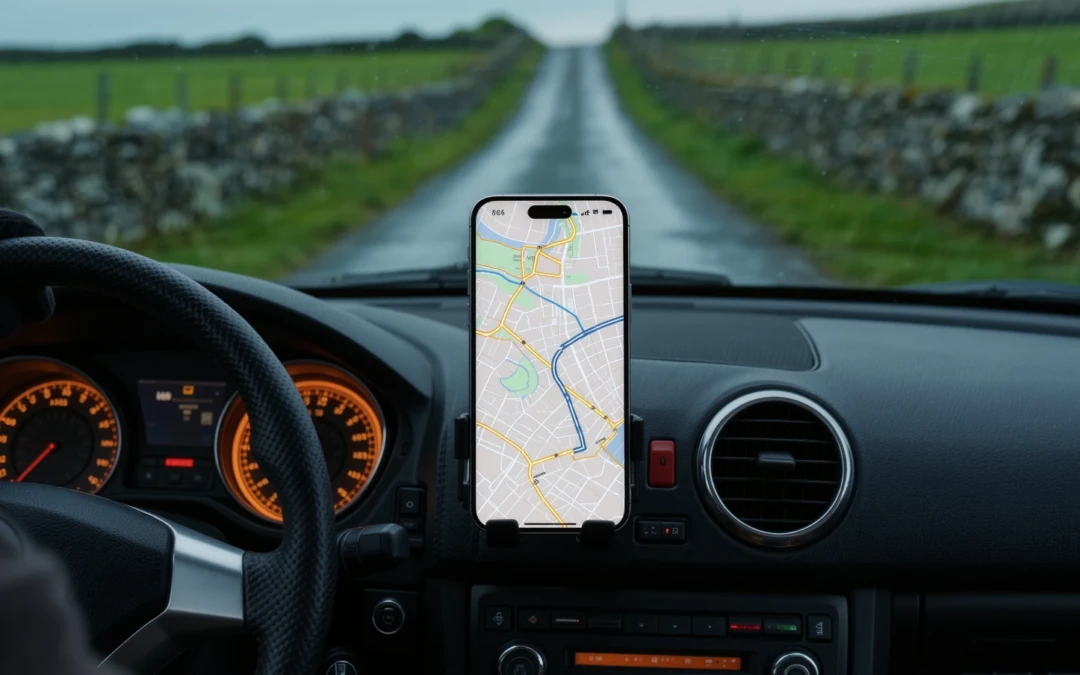
A phone in a holder is not held by you, so section 3(1) does not apply. The law does not prescribe where a holder must go. But the general view rule still applies: article 23 of S.I. 190/1963 requires a clear view of the road in front and to the sides, and the NCT fails objects in the driver’s field of view that materially affect it. Put the holder low, on a vent or the dash edge, not in the middle of the windscreen.
And remember S.I. 178/2014. Tapping a message on a phone in a holder is still sending a text.
Foreign drivers and hire cars
The rule applies to everyone driving in Ireland. If a fixed charge notice goes to a hire company as registered owner, the law gives the owner 28 days to name the driver (Road Traffic Act 2010, section 35(6)). The notice then comes to you.
Mistakes I see most often
- Phone on the shoulder for a quick call. The law calls that cradling, which counts as holding.
- Reading a WhatsApp at a red light. You are still driving in a public place, and email and messages count as text messages.
- A holder stuck in the middle of the windscreen, right in the wiper area.
Do the math: Pay on time: €120 and 3 points. Pay late: €180. Let it go to a summons: €240, or up to €2,000 and 5 points in court. A hands-free setup or voice control you already have costs €0.
FAQ
Can I use Google Maps on my phone? Yes, if the phone sits in a holder and you do not hold it. Set the route before you drive. The texting ban covers messages, not navigation, but holding the phone to type an address is holding.
Is a call through the car’s Bluetooth legal? Yes. A hands-free device is excluded from the definition for the holding rule. Voice dictation is also not sending a text under S.I. 178/2014.
What if I was calling 999? Section 3(7) gives you a defence if you were calling an emergency service on a prescribed number or dealing with a genuine emergency.
Where to check
Revised Road Traffic Act 2006, section 3 (updated to 1 July 2026) and Road Traffic Act 2002, First Schedule and section 3, at revisedacts.lawreform.ie; Road Traffic Act 2010, sections 35, 36 and 44; S.I. 178/2014 and S.I. 227/2024 on irishstatutebook.ie.
Ivan’s Take
€120 and 3 points for a glance at a message is a bad deal. Set the route, connect Bluetooth, put the phone in a low holder and leave it. The messages will still be there when you park.
Sources: Road Traffic Act 2006 (revised, updated to 1 July 2026) – s. 3; S.I. No. 178/2014 – Road Traffic Act 2006 (Restriction on Use of Mobile Phones) Regulations 2014; S.I. No. 227/2024 – Fixed Charge Offences Regulations 2024; Road Traffic Act 2002 (revised) – s. 3 and First Schedule; Road Traffic Act 2010 (revised) – ss. 35, 36, 44; S.I. No. 190/1963 – art. 23 (view of road).
Published:
More from this section
The AvtoGear weekly
Once a week: new tests, the best deals and one useful tip for your car. Nothing extra.
