








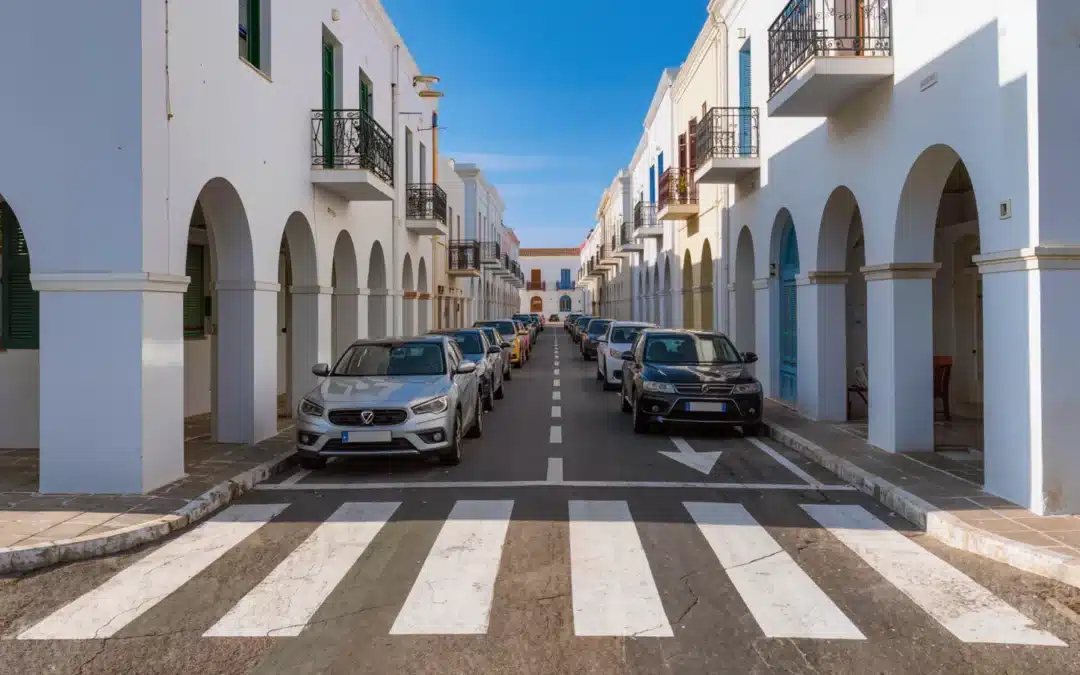
In short
- No stopping or parking on a pedestrian crossing or within 5 m of it, within 12 m of a bus stop, within 10 m of a junction, within 20 m of traffic lights or 12 m of a STOP or give-way sign.
- Most parking offences are E1-A, €30. Some are E1-B, €30 plus 10 days without licence. A disabled bay costs €150, 20 days without licence and 70 days without registration.
- If the car stays more than 3 hours after the ticket, a new offence can be recorded. The police can clamp or tow, and you pay for it.
On a Greek island in August, every metre of kerb looks like a parking space. Article 38 says which ones are not, and it gives exact distances.
The short answer: In Greece you may not stop or park on or within 5 m of a pedestrian crossing, within 12 m of a bus stop, within 10 m of a junction, within 20 m of traffic lights, within 12 m of a STOP or give-way sign, on pavements, or double-parked. Most offences cost €30; some add 10 days without licence; a disabled bay costs €150, 20 days without licence and 70 days without registration.
Where you may not stop or park
- On a pedestrian or cyclist crossing, and within 5 metres either side of it.
- Within 12 metres either side of a bus, trolley or tram stop.
- At junction entries and exits, and within 10 metres of the edge of the crossing road.
- On pavements, squares, pedestrian areas and cycle paths, unless a sign allows it.
- Within 20 metres of traffic lights and 12 metres of a STOP or give-way sign, or anywhere you hide a sign from other drivers.
- Within 5 metres of the corner where the building lines meet.
- On bridges and under them, on crests and on bends with poor visibility.
- On motorways and expressways outside marked parking areas, on acceleration and deceleration lanes, and in signed tunnels.
- On ramps for disabled people or within 0.50 m of them, and in disabled parking bays.
- At an electric vehicle charging point, unless you are an EV that is charging.
- On railway or tram lines, or so close that you block them.
Where you may stop but not park
- Within 15 metres before and after a level crossing.
- In front of a driveway, and opposite it on a narrow street.
- Where you block another car that is parked correctly.
- Next to another stopped or parked car (double parking). Two-wheelers are the exception.
- Within 5 metres of a fire hydrant.
- In front of hospital and clinic entrances, and in taxi spaces.
How to park
In towns, park as close as possible to the right edge. On one-way streets the left side is allowed too. With no pavement, leave at least 1 metre free for pedestrians. Park parallel to the kerb, on the side of your direction of travel. Outside towns, only in parking areas or on the shoulder, as far right as possible.
What it costs
- Crossings, bus stops, junctions, pavements, near lights and signs, fire hydrants, hospital entrances, taxi spaces, not parallel: category E1-A, €30.
- Motorways and expressways, acceleration lanes, tunnels, safety islands, EV chargers, level crossings, driveways, blocking a car, double parking, wrong parking outside towns: category E1-B, €30 plus 10 days without licence.
- Disabled ramps and bays: category E2-B, €150 plus 20 days without licence, and the registration is taken for 70 days.
- Blocking public transport where marked: category E3-B, €350 plus 30 days.
- On railway lines: €1,200, 60 days without licence, and prison of at least one year.
- Motorcycles and mopeds pay half.
- If the illegal parking continues more than 3 hours after the ticket, a new offence can be recorded.
Clamping and towing
The police can clamp a car or tow it away when it blocks traffic. The towing and storage costs are paid by the owner before the car is released.
What foreign drivers must know
No exception for rental cars or foreign plates. With a rental, the 10 days without licence hits you, the driver, and towing costs come on top.
Mistakes I see most often
- Parking right at the corner. Junctions need 10 metres.
- Two wheels on the pavement. That is parking on the pavement.
- Double parking with hazard lights for just a minute. E1-B: €30 and 10 days without licence.
Do the math
Double parking for five minutes to buy water: €30 plus 10 days without licence. A disabled bay for the same five minutes: €150, 20 days without licence and 70 days without registration. Walking 100 metres takes about a minute.
FAQ
How far from a pedestrian crossing must I park in Greece?
At least 5 metres on either side.
Can I park in an EV charging bay in Greece?
Only if you drive an electric vehicle and it is charging. Otherwise it is E1-B: €30 and 10 days without licence.
Can the police tow my rental car?
Yes, when it blocks traffic. The owner or holder pays towing and storage before getting it back.
Ivan’s take
I do not park where I have to hope. If you need the hazard lights to justify it, it is the wrong spot. In Greece, walk the extra 100 metres.
Where to check
The full text of Article 38 (stopping and parking) and Article 108 (fine categories) of Law 5209/2025 is linked below. Local municipal parking zones have their own rules and prices.
Sources: Ν. 5209/2025 (ΚΟΚ), άρθρο 38 – Στάση και στάθμευση; Ν. 5209/2025 (ΚΟΚ), άρθρο 108 – Κατηγορίες παραβάσεων.
Published:
More from this section
The AvtoGear weekly
Once a week: new tests, the best deals and one useful tip for your car. Nothing extra.
