








In short
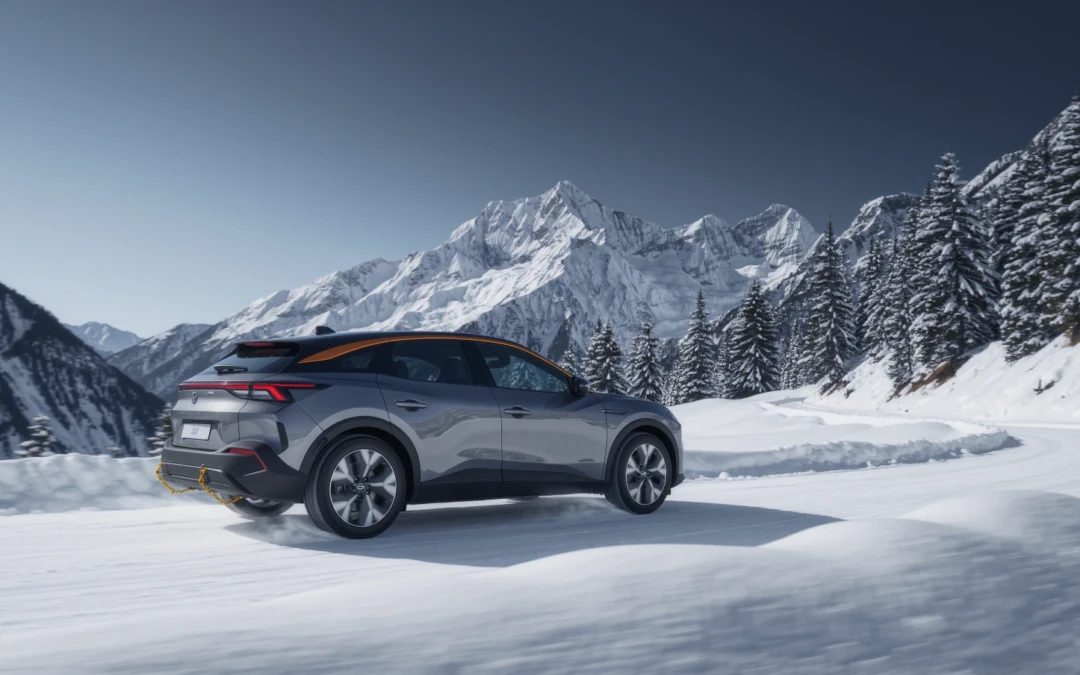
- From 1 November to 31 March, in marked mountain zones of 34 French departments, your car must have either 4 winter tyres (3PMSF symbol) or two snow chains or textile socks in the boot.
- The zone starts at the new B58 road sign and ends at B59, with a plate showing the winter period. Studded tyres are exempt.
- I found no official fine amount for this rule in the sources I could read, so I give none. The rule is still binding, and blocked mountain roads are the reason it exists.
If you drive to the Alps, the Pyrenees, the Vosges, the Jura, the Massif Central or Corsica this winter, you need to know one rule. It is a French rule, in force since the winter of 2021, and it applies to every car on those roads, not only to French cars. Here is what the Securite Routiere and Service-Public say.
Where and when the rule applies
Between 1 November and 31 March, in certain communes of the mountain massifs (Alps, Corsica, Massif Central, Jura, Pyrenees, Vosges), you must fit winter tyres or carry snow chains. 34 departments are concerned. The prefects drew up the lists of communes after consulting local elected officials. The Securite Routiere publishes a map and the list of prefectoral orders.
The zone is shown by road signs. Two panels, B58 at the entry and B59 at the exit, tell you that winter equipment is compulsory. A plate gives the winter period (1 November to 31 March). The Securite Routiere states that the signs must be installed by the road manager and that they are needed for the measure to be enforceable against you. Without the signs the measure cannot be enforced against drivers.
What equipment is accepted
For cars, vans and motorhomes (categories M1 and N1) you have a choice:
- Option 1: carry in the vehicle at least two chains, or equivalent removable anti-skid devices, able to equip at least two driving wheels. Metal chains and textile snow socks are both allowed.
- Option 2: fit at least 4 winter tyres, on at least 2 wheels of each axle.
Microcars (cars without a licence) are not concerned. Vehicles on studded tyres are exempt. If there is no snow or ice, the chains stay on board, in the car, ready to use.
What counts as a winter tyre
The Securite Routiere says winter tyres are those with the 3PMSF marking, the alpine symbol: a mountain with three peaks containing a snowflake. Service-Public describes it as the alpine symbol together with the letters M+S, M.S or M&S. Tyres marked only M+S do not count as winter tyres since 1 November 2024. You can still use them, but then you must also carry chains.
All-season tyres (4S, All Weather, All Season) have no regulatory definition. They count as winter tyres only if they carry the 3PMSF symbol.
Other signs and heavy vehicles
The older sign B26 keeps its meaning: on snowy roads, even outside the winter period, you must wear chains, not just carry them. Unless a plate says chains only, a vehicle with the equipment above is considered to satisfy B26. For buses, coaches and lorries the same choice applies. A lorry with a trailer or semi-trailer must always carry chains, even on winter tyres.
Fines
I could not verify a fine amount. The Securite Routiere press release of 2021 said that failure to comply would not be punished during the first winter. The Service-Public page I read on car equipment (verified 2 November 2026) states the rule but gives no figure for winter equipment, and I have no official fine table for it. So I do not quote a number. Remember the practical consequence: one unequipped car that blocks a mountain road is a problem for everyone.
Foreign and rental cars
The Securite Routiere says the obligation applies to vehicles driving in the zones set by the prefects, and it mentions no exception for foreign plates. If you rent a car in France for a ski trip, ask the rental company whether it comes with winter tyres or chains. I did not find an official rule on what the rental company must provide.
Mistakes I see most often
- Buying cheap M+S tyres and thinking they are enough. Without the alpine symbol you also need chains.
- Chains in the wrong size or never tried. Fit them at home once. The Securite Routiere advises practising before you leave.
- Putting chains on the non-driving wheels. They go on the driving wheels.
Do the math: The maths: the official pages give no fine, so I cannot compare it with a price. What I can count is the equipment: two chains for two driving wheels, or four winter tyres. Ask your tyre shop for a quote on both and compare them for your own trips.
FAQ
Are 4-season tyres allowed? Only if they carry the 3PMSF symbol. Without it, you need chains.
Do I need chains if there is no snow? In a signed zone, between 1 November and 31 March, you must have chains or winter tyres on board even if the road is dry.
Does it apply on motorways? It applies in the communes listed by the prefects and where the B58 sign is installed. Check the prefectural list for your route.
Ivan’s Take
My view: do not gamble on the missing fine. A mountain road blocked by one unequipped car is the reason this rule exists. Put a set of chains in the boot, fit them once in your driveway, and go. If you drive in the mountains every winter, 3PMSF tyres are the quiet solution.
Sources: Sécurité routière: Nouveaux équipements hivernaux (décret n° 2020-1264 du 16 octobre 2020; panneaux B58, B59, B26); Sécurité routière: Entrée en vigueur de l'obligation de détenir des chaînes ou d'équiper les véhicules de pneus hiver (1er novembre 2021); Service-Public: Équipements obligatoires en voiture (vérifié 02/11/2026); Sécurité routière: Conduire en hiver.
Published:
More from this section

The AvtoGear weekly
Once a week: new tests, the best deals and one useful tip for your car. Nothing extra.
