








In short
- From 1 August 2026, before a mobile automatic speed camera starts measuring, the police must put up an automatic-control warning sign: 300–500 m ahead outside built-up areas, 150–300 m ahead inside them.
- If that sign rule is broken, the speed measurement is invalid by law (Traffic Act § 199 lg 14).
- What the camera does catch still costs the owner €7 for every km/h over the limit (§ 262 p 1).
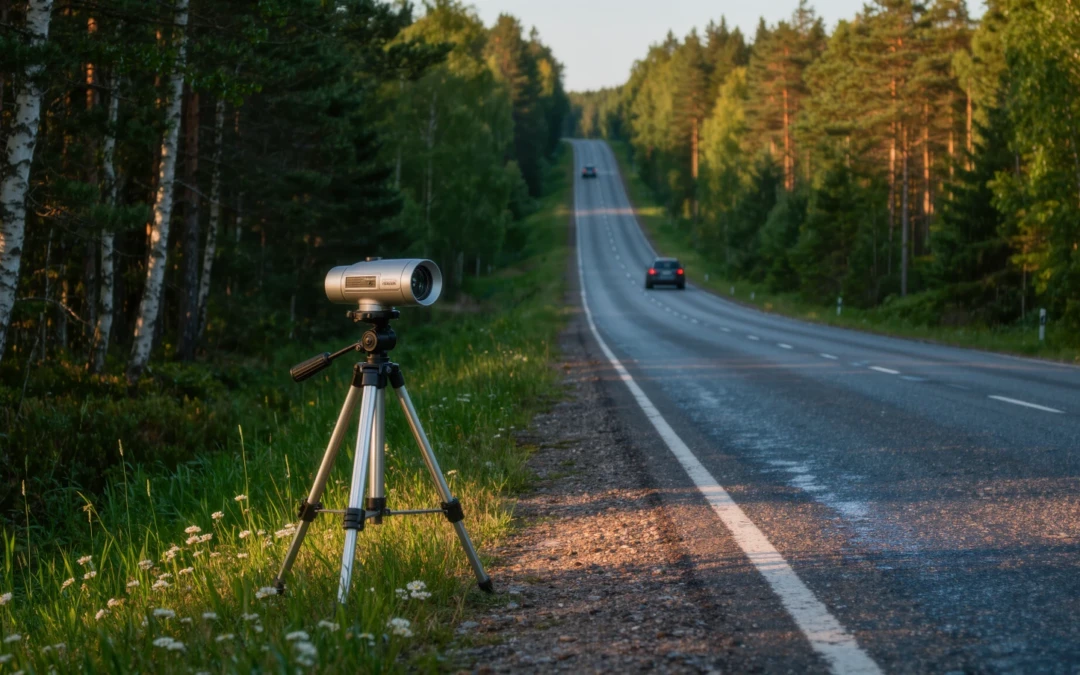
Estonia’s mobile speed cameras are the small units that appear by the roadside for a day and then move on. Since 1 August 2026 they can no longer surprise you. The law now says when and where the warning sign must stand, and a measurement taken without it does not count.
The rule in detail
The change comes from a short amending act (Liiklusseaduse täiendamise seadus, RT I, 09.07.2026, 5) that added three paragraphs to Traffic Act § 199, the section on traffic supervision methods. They read, in short:
- Lg 13: when a mobile automatic traffic supervision system is used to measure speed, the supervisor must place an automatic-control warning sign before measuring starts: 300 to 500 metres before the speed meter outside a built-up area, and 150 to 300 metres before it inside a built-up area.
- Lg 14: if these requirements are breached, the result of the speed measurement is invalid.
- Lg 15: the detailed rules for placing the sign are set by a Government regulation.
An automatic traffic supervision system, in the Traffic Act’s definition (§ 2 p 31), is a set of devices: a surveillance camera, a speed meter when speed is measured, a documenting device and other equipment. The new distance rule names only the mobile (teisaldatav) version. Fixed roadside cameras are not covered by it.
Nothing else in § 199 disappeared. Police can still supervise traffic with marked cars, covertly with unmarked cars and plain-clothes officers, with mobile or stationary technical devices, or in combined operations (§ 199 lg 1). The sign rule is about the unmanned mobile camera, not about a patrol that stops you.
Fines
The sign changes when a measurement is valid. It does not change the price of speeding:
- Camera notice to the owner (warning fine, Traffic Act § 262 p 1): €7 × every km/h over the limit, maximum €420 (Code of Misdemeanour Procedure § 541 lg 4).
- Stopped by police, short procedure (§ 2621 lg 2 p 4): €7 × every km/h, maximum €160.
- Full procedure (§ 227, penalty unit €8): up to 20 km/h over – up to €240; 21–40 km/h – up to €800 or loss of licence up to 6 months; 41–60 km/h – up to €1,600, arrest or loss of licence up to 12 months; over 60 km/h – up to €2,400, arrest or loss of licence up to 24 months.
Foreign drivers and rental cars
The Traffic Act applies to foreign drivers and foreign-registered vehicles in Estonia unless an international agreement says otherwise (§ 1 lg 3), so the sign rule protects you too. A camera notice goes to the registered owner or responsible user (Code of Misdemeanour Procedure § 541); for an Estonian rental car that is the rental company. The notice must be paid or contested within 30 days of receipt (§ 542, § 544). If you believe the sign was missing or in the wrong place, the contest is your only route – an unpaid notice simply goes to a bailiff.
Mistakes I see most often
- Slamming the brakes at the sign. You have 150–500 metres. Slow down smoothly; a rear-end crash costs more than any fine.
- “No sign, no camera.” The rule covers only mobile automatic cameras. Fixed cameras and police patrols do not need this sign.
- Ignoring the letter because “the sign was wrong”. Invalidity has to be raised by contesting within 30 days; silence means you pay, plus enforcement costs.
Do the math: The math: 90 km/h road, mobile camera reads 104 km/h → 14 × €7 = €98. Same road, you see the sign at 400 m and ease back to 90 → €0. At 90 km/h, 300–500 metres give you 12 to 20 seconds to fix your speed.
FAQ
Does the 300–500 m rule apply to fixed speed cameras? No. Traffic Act § 199 lg 13 speaks only of mobile (teisaldatav) automatic supervision systems used to measure speed.
Does the sign show the exact spot of the camera? No. The law gives a distance range: 300–500 m outside built-up areas and 150–300 m inside them. The exact placing rules are in the Government regulation under lg 15.
Since when does a measurement without a sign count as invalid? From 1 August 2026, the date the amending act entered into force. It is not retroactive.
Where to check
Riigi Teataja: Traffic Act (Liiklusseadus), consolidated text RT I, 11.07.2026, 45, in force from 1 October 2026 – § 2 p 31, § 199 lg 1–15, §§ 227, 262, 2621; amending act RT I, 09.07.2026, 5; Code of Misdemeanour Procedure §§ 541–544.
Ivan’s Take
This is a fair rule. A camera that warns you does what a camera should do: it slows people down where it stands. I would still drive as if every bend hides one, because fixed cameras and patrols never needed a sign.
Sources: Riigi Teataja – Liiklusseadus (RT I, 11.07.2026, 45) § 2 p 3¹, § 199, §§ 227, 262, 262¹; Riigi Teataja – Liiklusseaduse täiendamise seadus (RT I, 09.07.2026, 5); Riigi Teataja – Väärteomenetluse seadustik §§ 54¹–54⁴.
Published:
More from this section
The AvtoGear weekly
Once a week: new tests, the best deals and one useful tip for your car. Nothing extra.
