








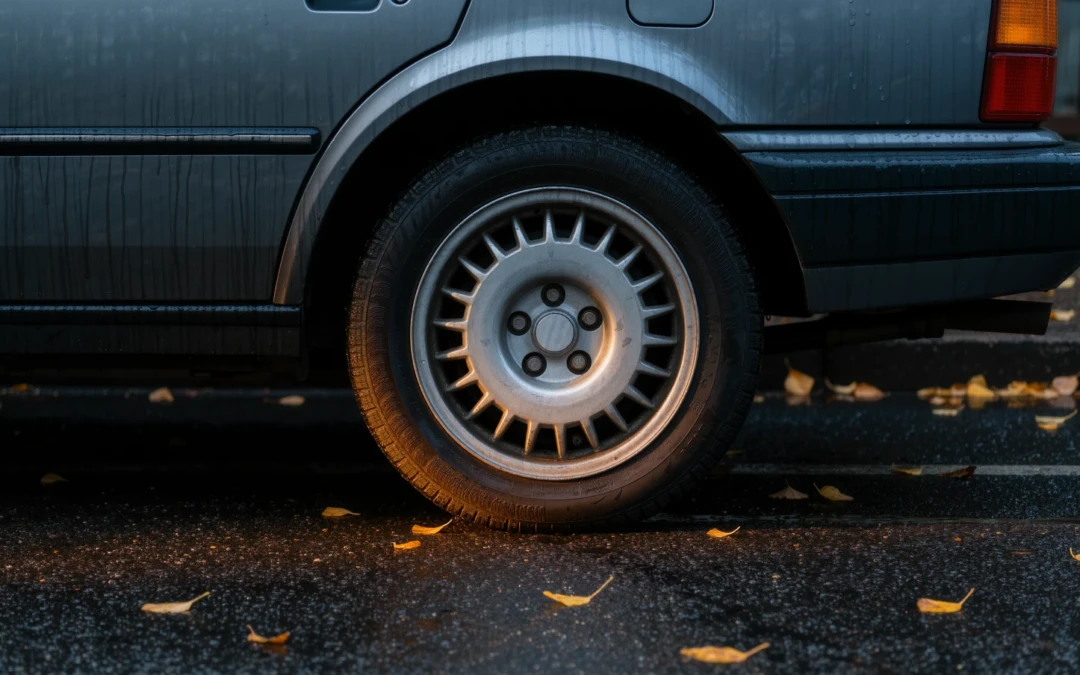
In short
- Since 1 July 2025 § 67(3) of the Danish Road Traffic Act makes the driver responsible for making sure the vehicle does not have obviously unsuitable tyres for the conditions.
- Denmark did not introduce a general winter-tyre season. But on snow- or ice-covered roads, tyres that are not type-approved winter tyres count as obviously unsuitable, and in hard winter conditions only tyres with the 3PMSF snowflake mark are suitable.
- The bill sets no special amount. The fine falls under § 118, and the starting minimum for any offence with a motor vehicle is 1,000 kr (about €134).
Denmark looked at a winter-tyre law and decided against it. Instead, it gave the police a clear tool for the bad cases. Since 1 July 2025 the person behind the wheel, not just the owner, answers for tyres that obviously do not fit the road conditions. Here is what that means on a snowy morning.
The rule in detail
Law no. 567 of 27 May 2025 added a few words to § 67(3) of the Road Traffic Act (Færdselsloven, consolidated LBK no. 118 of 12 January 2026). The driver must at all times make sure the vehicle is in a safe state, including “that the vehicle is not fitted with obviously unsuitable tyres”. It entered into force on 1 July 2025.
The bill (L 165 of 12 March 2025) explains how to read it. The test is the actual road conditions, the tyre type and the tyre condition:
- On snow- or ice-covered roads, tyres that are not type-approved winter tyres are obviously unsuitable.
- In hard winter conditions, tyres that are not type-approved winter tyres with the snowflake mark (3PMSF) are unsuitable.
- Exception: special tyres or terrain tyres built for mixed conditions or off-road use.
- It is not meant for grey-zone cases. The police judge each case at a roadside check.
The same bill says plainly that there is no need for a general legal requirement to switch to winter tyres in the winter half of the year. So on a dry, cold road in December, summer tyres are not illegal by themselves.
Other tyre rules that still apply
- Tread depth: a passenger car (M1) needs at least 1.6 mm, measured in the main grooves (detailed vehicle rules, BEK no. 1484 of 3 December 2025, in force since 1 January 2026).
- Studded tyres: only from 1 November to 15 April, and only if all wheels have them (same order).
- If a vehicle is a danger to road safety, the police can take its number plates (§ 77(1) of the Act).
Fines
Breaking § 67 is punished with a fine under § 118(1). The bill gives no fixed amount for unsuitable tyres. Under § 118 a, fines for offences with a motor vehicle start at a minimum of 1,000 kr (€134), according to the Director of Public Prosecutions’ general guideline (1 January 2026). I could not verify a specific tyre fine, so I give only that minimum. Rate: 100 EUR = 747.54 DKK (Danmarks Nationalbank, 12 November 2026).
Foreign drivers and rental cars
The duty sits with the driver, so it applies to you in a foreign or rented car too. If you pick up a rental car in Copenhagen in January and snow is forecast, check the sidewall for the mountain-and-snowflake symbol before you leave the lot. If you arrive with 3PMSF winter tyres already fitted, you meet the rule.
Mistakes I see most often
- Thinking “no winter-tyre law” means anything goes. On snow and ice it does not.
- Trusting M+S alone in hard winter conditions. The bill names the 3PMSF snowflake mark.
- Driving on worn winter tyres. A tyre at the 1.6 mm wear indicator is legal on paper but weak on snow.
Do the math: The math: the minimum fine is 1,000 kr (€134). A ditch, a tow and a bumper cost far more. If you live in Denmark and drive in winter, a set of 3PMSF tyres pays for itself the first time it keeps you on the road.
FAQ
Do I need winter tyres in Denmark from a certain date? No. There is no fixed season. The rule bites when the road is snowy or icy and your tyres are obviously unsuitable.
Are all-season tyres enough? On snow or ice, they must be type-approved winter tyres. In hard winter conditions, they need the 3PMSF snowflake mark. Check the sidewall for the mark.
Who is fined, the owner or the driver? The driver, under § 67(3). The owner still answers for the vehicle being in a lawful state under § 67(2).
Ivan’s Take
I like this approach. No calendar rule that forces everyone to change tyres on a set date, but a clear line for the person who drives into a snowstorm on summer tyres. For me the 3PMSF mark is the simple answer for anyone who drives in Denmark between November and March.
Sources: Færdselsloven (LBK nr. 118 af 12/01/2026) §§ 67, 77, 118, 118 a; Lov nr. 567 af 27/05/2025 og lovforslag L 165 (2024/1) med bemærkninger; Detailforskrifter for køretøjers indretning, udstyr og anvendelse (BEK nr. 1484 af 03/12/2025); Rigsadvokatmeddelelsen: Generelle retningslinjer for sanktionspåstande i færdselssager (01/01/2026); Danmarks Nationalbank – exchange rates.
Published:
More from this section

The AvtoGear weekly
Once a week: new tests, the best deals and one useful tip for your car. Nothing extra.
