








In short
- An inverter turns the car’s 12 volts into 230 volts, so you can plug in a normal charger.
- Through the cigarette lighter socket the practical limit is about 150 watts. Bigger units must be wired to the battery.
- A quality pure sine unit like the Dometic SinePower DSP 412 (350 W) costs 149 euros. For a laptop alone, a USB-C car charger may be all you need.
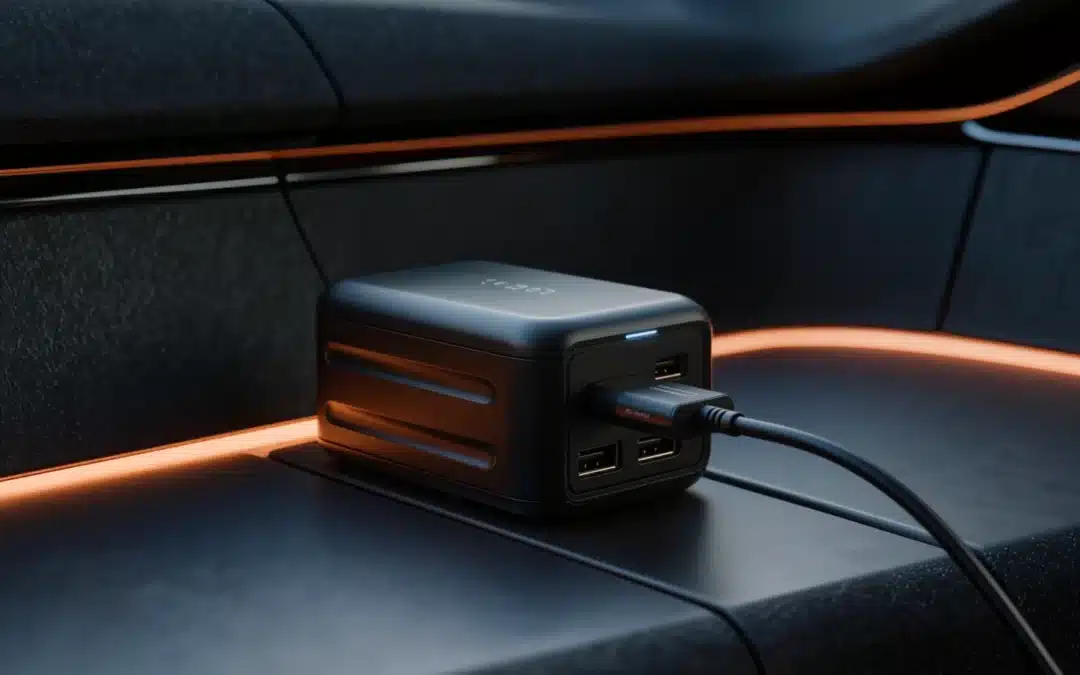
Laptop at 8 %, two hours of motorway ahead. Can you plug it into the car? Yes, with an inverter. Can you also make coffee? No. The difference is watts, and most people buy the wrong size. Here is how to get it right.
The short answer: Through the 12V socket plan on about 150 watts, enough for a laptop or camera charger; anything bigger needs an inverter wired to the battery, and a kettle or hair dryer is out of reach.
How it works
Your car runs on 12 volts DC. Home devices want 230 volts AC. The inverter converts one into the other and gives you a normal socket.
Every conversion loses energy. Good units are above 90 % efficient. Dometic states more than 90 % for its SinePower DSP 412.
The 150-watt wall
The 12V socket in your dashboard is fused, usually at 10 to 15 amps. At 12 volts that is roughly 120 to 180 watts. Inverter makers say the same thing in their manuals: above about 150 watts, connect directly to the battery with clamps or cables.
What fits under 150 watts? A laptop charger, camera and drone batteries, an electric toothbrush, a small fan. What does not? A kettle, a hair dryer, a coffee machine. A 2,000 W kettle would pull about 170 amps from 12 volts. No socket and no normal inverter does that.
Pure sine or modified sine
Cheap inverters make a modified sine wave, a stepped copy of mains power. It is fine for simple loads like lamps and heating elements.
Sensitive devices want a pure sine wave like the grid. Dometic names electric toothbrushes, laptops and TVs as examples. Pure sine costs more, but your chargers run cooler and quieter.
What to look for
- Continuous power, not peak. Peak is a few seconds. Continuous is what matters.
- Pure sine if you charge laptops or anything with a motor.
- Protection: overload, overheating, under- and overvoltage. The Dometic DSP 412 has all four and restarts by itself.
- A low-voltage cut-off so it shuts down before your battery is empty.
- A fan that is quiet and a place to mount it with air around it.
Real options
- Under 150 W, plug-in: fine for a laptop and phone chargers. Check the continuous rating and the fuse in the plug.
- Dometic SinePower DSP 412: pure sine, 350 W continuous, more than 90 % efficient, works from 0 to 50 °C. Official price 149 euros. At 350 W it must be wired to the battery, not the socket.
- No inverter at all: many laptops charge over USB-C. A strong USB-C car charger skips the conversion loss. See our Electronics & Gadgets guides on chargers.
Step by step
- Add up the watts of what you want to run. The label on the charger shows it.
- Add 20 to 30 % headroom and pick the continuous rating above that.
- Under about 150 W: plug-in is fine. Above: wire it to the battery with the cable size and fuse the manual asks for.
- Run the engine while you use it for longer than a few minutes.
- Switch it off when you leave the car. Some units draw power even with nothing plugged in.
Mistakes to avoid
- Plugging a 300 W unit into the socket and blowing the fuse.
- Buying by peak watts printed in big numbers on the box.
- Using it with the engine off for hours, especially in winter.
- Hiding it under a seat with no airflow. It needs to shed heat.
- Buying an inverter for a laptop that already charges over USB-C.
Do the math: A 65 W laptop charger through a 90 % efficient inverter pulls about 72 W, so roughly 6 amps at 12 volts. Three hours with the engine off is about 18 Ah, a big bite out of a typical car battery on a cold morning. A good 350 W pure sine inverter costs 149 euros. If all you charge is a USB-C laptop, a quality USB-C car charger may do the same job for far less and with no conversion loss.
Pros and cons
- Pro: any normal charger works in the car.
- Pro: useful for laptops on long drives, camping and work trips.
- Con: the socket limits you to about 150 W.
- Con: conversion losses and a real risk of a flat battery with the engine off.
- Con: high-power devices like kettles are out of reach.
FAQ
Can I run an inverter with the engine off? Briefly, yes. For longer use, run the engine. A low-voltage cut-off helps, but a cold battery has less to give.
Will it damage my laptop? A pure sine unit gives power like a wall socket. Cheap modified sine units can make some chargers hum or run hot.
Do I need an electrician to install one? A plug-in unit, no. A unit wired to the battery needs the right cable size and an inline fuse as the manual says. If you are not sure, let a workshop do it.
Ivan’s Take
I would first check whether my laptop charges over USB-C. If it does, I skip the inverter. If I really need 230 volts, I buy pure sine and stay under 150 watts on the socket. Anything bigger means wiring to the battery, and that is a job for someone who knows fuses.
Sources: Dometic SinePower DSP 412; Eaton Tripp Lite PV150.
Published:
More from this section

The AvtoGear weekly
Once a week: new tests, the best deals and one useful tip for your car. Nothing extra.
