








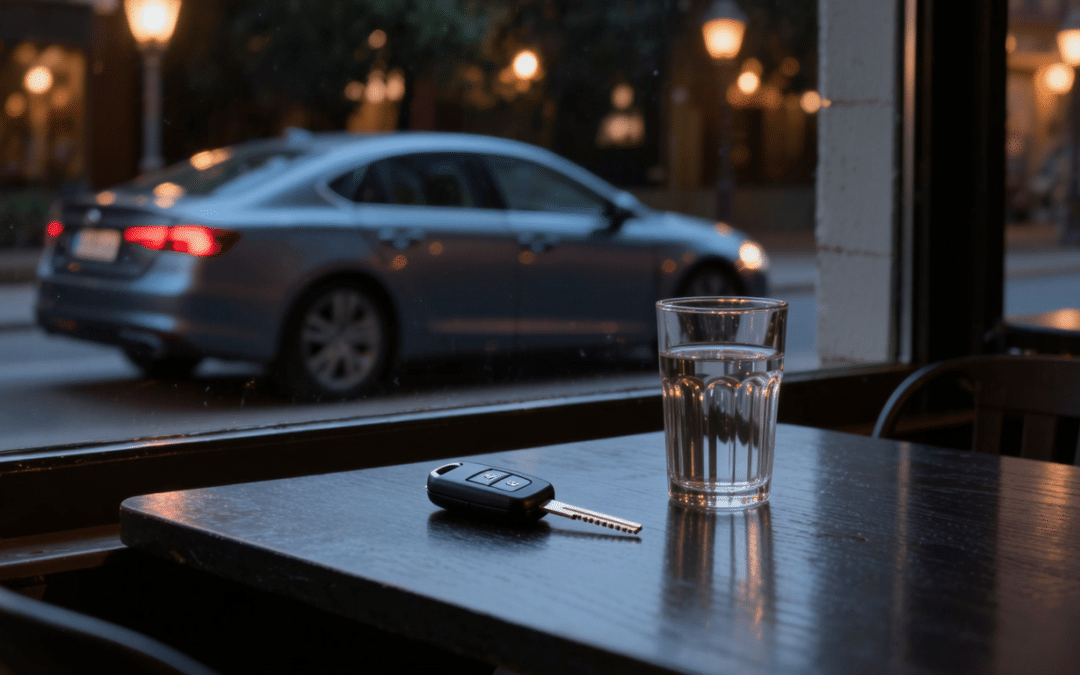
In short
- General limit: more than 0.3 g/kg of alcohol in the blood means you are treated as driving under the influence (Article 174(2) ZOBS).
- Zero tolerance (0.0 g/kg): drivers under 21, drivers with less than three years of experience, professional drivers, instructors, learners and drivers of C and D category vehicles (Article 174(3)).
- Ordinary fines run from 50 KM (€25.56) at 0.0–0.3 g/kg to 100–300 KM (€51.13–€153.39) plus a driving ban at 0.8–1.5 g/kg.
Bosnia and Herzegovina has a low general limit and a zero limit for several groups of drivers. This article covers the ordinary bands up to 1.5 g/kg. What happens above 1.50 g/kg, with reckless driving and police detention, is covered in a separate article.
The general limit: 0.3 g/kg
A driver may not drive, or start driving, under the influence of alcohol (Article 174(1)). A driver is considered under the influence if blood analysis or another method shows more than 0.3 g/kg of alcohol, or if a breath device shows a reading corresponding to more than 0.3 g/kg (Article 174(2)). The same article adds a second route: a professional examination showing signs of impairment caused by alcohol is enough, whatever the number.
A driver counts as having started driving once the vehicle has been set in motion from its place (Article 174(4)). Sitting in a parked car is not the same thing.
Zero tolerance for some drivers
For the groups below, anything above 0.0 g/kg counts as being under the influence (Article 174(3)):
- drivers of vehicles in categories C, CE, D and DE and subcategories C1, C1E, D1 and D1E, while driving a vehicle of that category;
- drivers of vehicles used in public transport, while doing public transport;
- drivers for whom driving is the main occupation, while working;
- driving instructors during practical training, and learner drivers during practical training;
- drivers under 21 years of age or with less than three years of driving experience.
The last group is the one that surprises people. A 35-year-old who got a licence two years ago is also in the zero group.
- Bosnia and Herzegovina: with a roof box and bikes on the back, lights and plate stay visible and overhang is capped
- Bosnia and Herzegovina: aftermarket LED and xenon bulbs, spotlights and roof bars under the vehicle rulebook
- Bosnia and Herzegovina: your own number plates are fine on holiday, but a move starts a three-month clock
Ordinary fines
The penalty depends on the measured level. The law states amounts in KM; the euro values use 1 EUR = 1.955830 KM.
- 0.0 to 0.3 g/kg (zero-limit groups): 50 KM (€25.56), Article 237(1), point 26a.
- More than 0.3 up to 0.8 g/kg: 50–250 KM (€25.56–€127.82) and 1 or 2 penalty points, Article 236(1), point 27 and (3).
- More than 0.8 up to 1.5 g/kg: 100–300 KM (€51.13–€153.39), a driving ban of 1 to 4 months and 2 penalty points, Article 235(1), point 26, (2) and (4).
- If a 0.8–1.5 g/kg offence causes an accident: 300–1,000 KM (€153.39–€511.29) and a ban of 1 to 6 months, Article 235(3).
Where an offence in the 0.3–0.8 g/kg band causes immediate danger or an accident, Article 236(2) raises the fine to 100–300 KM, with one or two points and a possible ban of up to two months.
Refusing the test
A driver who refuses an examination with the proper devices, or a professional check for alcohol or drugs, faces the maximum fine of 1,000 KM (€511.29), a driving ban of 2 to 6 months and 2 penalty points (Article 234a(1), point 10, (2) and (5)). Refusing is not a cheap way out.
After an accident
A person who took part in an accident with injured or dead persons or major material damage may not drink alcohol, or take drugs or medicines that must not be used before and during driving, until the on-site investigation is done (Article 159(1)). Do not open the bottle from the boot to calm your nerves.
Passengers
A passenger who is obviously under the influence of alcohol or drugs may not travel on the front seat of a car (Article 34(2)). The driver is fined 40 KM (€20.45) under Article 238(1), point 1a.
Foreign drivers and rental cars
The articles quoted draw no line between local and foreign drivers. The limits are described by the driver’s age, experience and the work they do, not by the country of the licence. If you are under 21 or hold a recent licence, assume zero.
Mistakes I see most often
- Treating 0.3 g/kg as allowed for everyone. For the zero groups, any reading above 0.0 is a fine.
- Forgetting that signs of impairment can be enough even with a low reading.
- Thinking that the morning after is automatically safe. The limit applies to what is in your blood when you drive.
Do the math: Do the math: a 22-year-old with a reading of 0.2 g/kg pays 50 KM (€25.56). A 30-year-old with ten years of driving and the same reading is under the 0.3 limit. At 0.9 g/kg the minimum is already 100 KM (€51.13), a one-month driving ban and 2 points.
FAQ
What is the general alcohol limit? More than 0.3 g/kg of alcohol in the blood counts as being under the influence (Article 174(2)).
Who must drive with 0.0 g/kg? Drivers under 21, drivers with less than three years of experience, professional and public-transport drivers, instructors, learners and C and D category drivers (Article 174(3)).
What is the fine for 0.5 g/kg? 50–250 KM (€25.56–€127.82) and one or two penalty points under Article 236(1), point 27.
Where to check
Read Articles 34, 159, 174, 234a, 235, 236 and 237 of the Law on the Basics of Road Traffic Safety in Bosnia and Herzegovina (consolidated text with the 2026 amendments) and the Official Gazette of BiH No. 35/26. The fixed rate is published by the Central Bank of Bosnia and Herzegovina.
Ivan’s Take
My rule is the cheapest one: if you drink, you do not drive. If you are young, new or a professional, there is not even a grey zone. Zero means zero.
Sources: ZOBS – consolidated text (Paragraf); Službeni glasnik BiH 35/26; Central Bank of Bosnia and Herzegovina – exchange rate.
Published:
More from this section

The AvtoGear weekly
Once a week: new tests, the best deals and one useful tip for your car. Nothing extra.
