








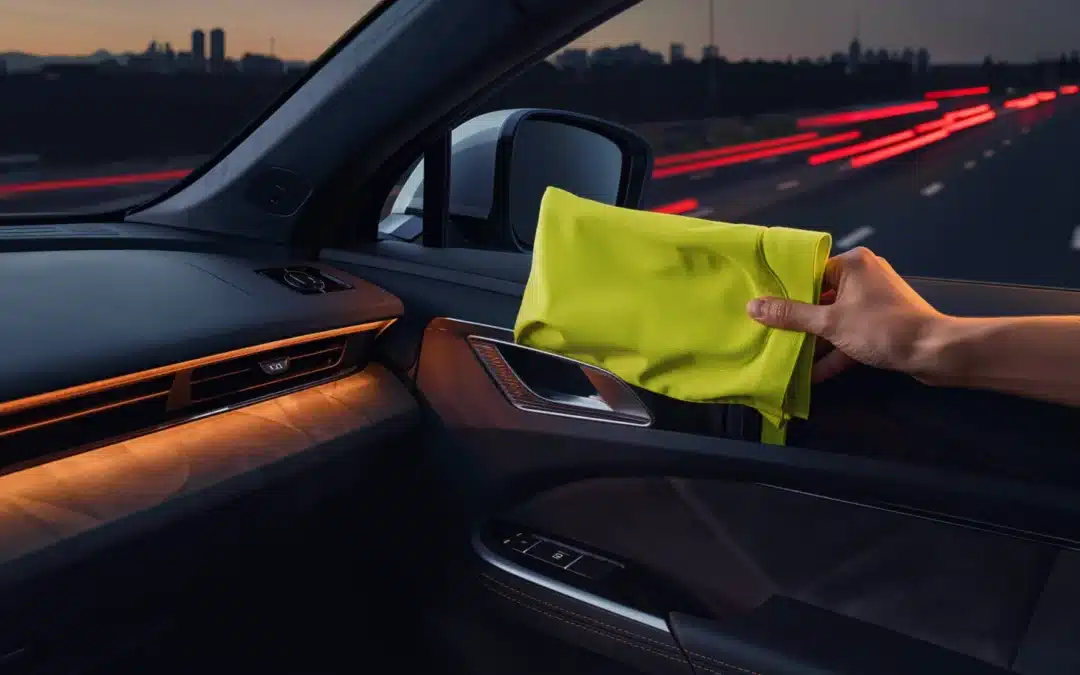
In short
- On a motorway or expressway, the driver of a broken-down car who ends up where stopping and parking are banned must wear a retro-reflective vest as soon as they leave the vehicle (Art. 51.4).
- The law speaks of wearing the vest, not of where you store it. Keep it in the cabin, within reach of the driver’s seat.
- The article has no assigned degree, so it is a first-degree offence: €64 plus a €10.67 administrative fee on the spot.
The most dangerous few metres of a breakdown are the ones between the driver’s door and the barrier. Belgian law does not leave that walk to chance. It tells the driver to put on a vest the moment the car is left. Here is exactly what the text says, and what it does not say.
What the rule says
Article 51.4 of the Royal Decree of 1 December 1975 reads, in substance: when, on motorways and expressways, the driver of a broken-down vehicle ends up in a place where stopping or parking is not allowed, they must wear a retro-reflective safety vest as soon as they leave the vehicle.
Three details matter:
- It applies on motorways and expressways, the roads where stopping is banned and traffic is fast.
- It applies to the driver. The article does not mention passengers.
- The trigger is leaving the vehicle. The vest has to be on before your feet touch the road, so it has to be within reach inside the cabin.
What the law does not say
Article 81.2 lists the accessories that must be in every car: a warning triangle, one or two fire extinguishers and a first-aid kit, as set by the technical regulation for cars. A vest is not on that list. In other words, no article I read tells you to buy one, yet Article 51.4 makes it impossible to comply without one. If you drive on motorways, treat it as compulsory kit.
The vest is only one part of the breakdown routine. The triangle, the distances and the sequence are covered in the separate articles on the warning triangle and on motorway breakdown safety. Here the focus is the vest.
What changes with the 2027 Code
Vias institute summarises the new Code of the Public Road for drivers. The vest duty will cover motorways and expressways and also tunnels. It will apply to the driver of a vehicle that is broken down, has been in an accident or has lost its load, when the vehicle is in a place where stopping or parking is banned.
Fines
Offences without an assigned degree are first-degree offences, and Article 51 is not on the higher-degree lists I read. The first-degree scale applies:
- Immediate payment: €64, plus the administrative fee of €10.67 (2026 rate).
- Settlement: €94, plus the fee. Not possible for people who live in Belgium, who are in principle summoned.
- Payment order: €127, plus the fee.
- Court: €100 to €2,500, excluding costs.
If the driver is absent or cannot follow police orders, Article 51.5 lets the competent person move the vehicle and load. On motorways and expressways they always do it, at the risk and cost of the driver.
Foreign drivers and rental cars
The rule applies to every driver on a Belgian motorway, whatever the plates. Check at pickup that the rental car has a vest in the cabin, not only in the boot. If it does not, ask the counter. A vest costs a few euros. A stranded driver in dark clothes at night is the real risk.
Mistakes I see most often
- Keeping the vest in the boot. To reach it you have to leave the car first.
- Putting it on after the walk to the barrier. The law says as soon as you leave the vehicle.
- Assuming one vest in the car covers the whole family. The rule names the driver, but I would put one on every person who steps out.
Do the math: Do the math: no vest after leaving a broken-down car on a motorway: €64 + €10.67 = €74.67 on the spot, or €100 to €2,500 in court. A vest in the door pocket costs you nothing after the first purchase.
FAQ
Do passengers also need a vest in Belgium? Article 51.4 names the driver. Passengers are not mentioned.
On which roads does the vest rule apply? On motorways and expressways today. The new Code adds tunnels and extends the duty to accidents and lost loads.
Which number do I call? 112 for ambulance and fire, 101 for urgent police help. 112 is free across Europe.
Where to check the official rules
Read Articles 51 and 81 of the Royal Decree of 1 December 1975, the first-degree fine table and the summary of the 2027 Code on wegcode.be and codedelaroute.be. Vias institute publishes them with the support of the FPS Mobility and Transport. Emergency numbers are on 112.be.
Ivan’s Take
My vest lives in the driver’s door pocket, in every car I drive. If I have to open the boot on a motorway shoulder to find it, I have already lost the point of the rule. Buy one, put it within reach, and move on.
Sources: Traffic regulation (Royal Decree of 1 December 1975), arts. 51, 81; Code of the Public Road: what changes for drivers (2027); Offences by degree, 2026 rates; 112.be: Belgian emergency numbers.
Published:
More from this section
The AvtoGear weekly
Once a week: new tests, the best deals and one useful tip for your car. Nothing extra.
