








In short
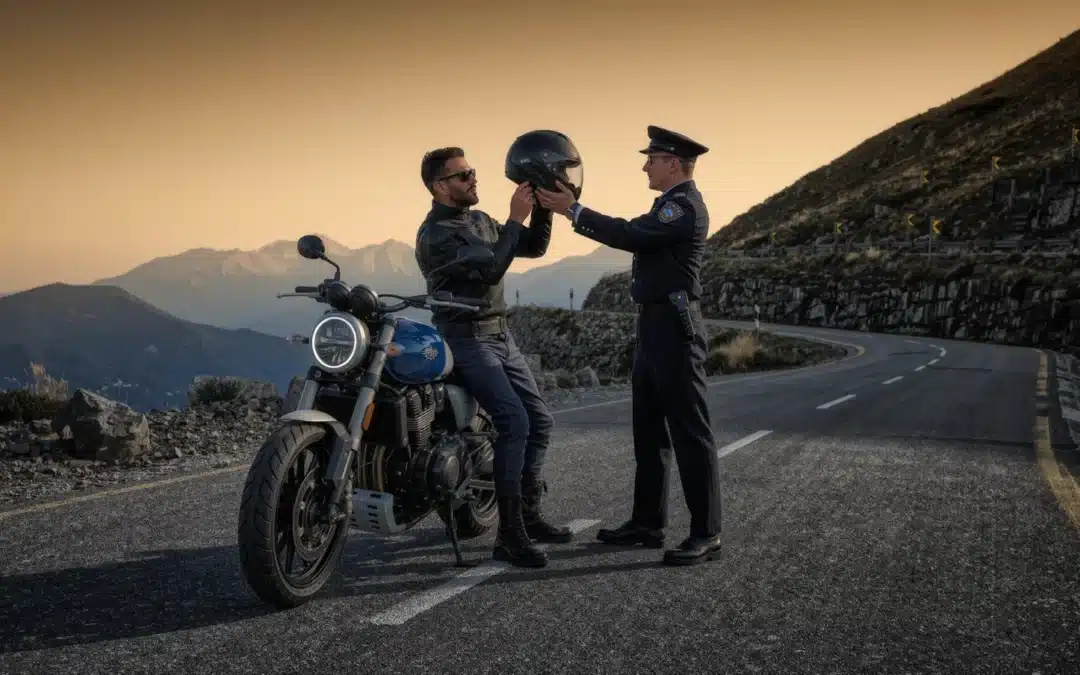
- Riders of mopeds and motorcycles of any engine size, and their passengers, must wear a type-approved helmet on every trip.
- The fine is 1,000–3,000 lek (€11–33). If a minor rides without one, the vehicle is impounded for 30 days instead.
- Outside towns at night and in fog, snow or heavy rain, riders also need an approved high-visibility vest or reflective gear.
Is a €33 helmet fine worth worrying about? On its own, barely. But in Albania the helmet rule comes bundled with lights, vest and passenger rules, and some of them end with your bike parked in a police yard for a month. The helmet is the cheapest part of the deal. Here is the full package from Articles 150, 168 and 169 of the Albanian Road Code.
Who must wear a helmet
Article 169 makes a protective helmet of an approved type compulsory while moving, in line with the norms set by the responsible ministry. It applies to:
- riders of mopeds and two-wheel motorcycles;
- riders of motorcycles of any engine size, including those with a sidecar;
- passengers, including minors.
The key words are “approved type”. A novelty half-shell bought at a beach market is not what the Code has in mind. The ministry treats unapproved helmets seriously enough to fine anyone who imports, produces for sale or sells them 10,000–40,000 lek (€110–440), and unused stock can be confiscated.
The Code speaks of putting the helmet on your head during the journey. A helmet hanging from the mirror or sitting unfastened on the back of your head does not do that job, and no officer will see it as protection.
The rules that come with it
The helmet is only one of several duties for two-wheelers. Article 150 obliges moped and motorcycle riders to use dipped headlights for the whole journey, on every type of road, day and night. Article 169 point 5 adds visibility: on interurban roads, from half an hour after sunset to half an hour before sunrise, and in daytime fog, snow or heavy rain, riders must wear an approved fluorescent or reflective vest, or technical clothing with reflective elements.
Article 168 covers how you ride. Mopeds may not carry anyone except the rider. On a motorcycle, the passenger must sit in a stable, balanced position on the seat designed for it. Riders must keep their hands on the handlebar and may not lift the front wheel.
Fines in euros
Converted at the Bank of Albania official rate of 90.84 lek per euro (6 November 2026), rounded:
- No helmet or no approved helmet: 1,000–3,000 lek (€11–33). If the passenger is a minor, the rider pays.
- Minor rider without a helmet: no fine, but the vehicle is impounded for 30 days.
- No reflective vest or gear when required: 1,000–3,000 lek (€11–33).
- Riding without dipped headlights: 1,000–3,000 lek (€11–33).
- Riding and passenger rules in Article 168: 1,000–4,000 lek (€11–44). For a motorcyclist breaking the riding or no-passenger rules, the bike is also held for 30 days.
What foreign riders and scooter renters must know
Renting a scooter in Ksamil or Himarë is easy. Getting a decent helmet with it is not always. Ask to see the approval label inside the helmet, check the size and test the strap before you ride off. If the rental helmet is a joke, bring your own from home. It fits better and you know its history.
Touring on your own bike? Your helmet with a recognised approval label is the right starting point. Pack a reflective vest too. The coastal roads get dark quickly after sunset, and the UK Foreign Office warns that even major routes often have no street lighting and that potholes and unlit vehicles are common at night.
Mistakes to avoid
- Letting your passenger ride without a helmet. You pay the fine.
- Riding with the strap open “because it is only to the beach”.
- Switching off the headlight in daylight. On a two-wheeler it stays on all the time.
- Leaving the reflective vest in the hotel and riding back after dark on an interurban road.
- Taking a second person on a moped. That is banned outright.
Do the math: The helmet fine tops out at 3,000 lek (€33), the vest and light fines at the same level. Break the riding or passenger rules on a motorcycle and you lose the bike for 30 days on top of up to 4,000 lek (€44). On a rented scooter, ask your rental company what a month off the road costs you before you take that risk. An approved helmet and a vest cost a fraction of that.
FAQ
Do passengers need a helmet in Albania? Yes. The duty covers motorcycle passengers, including minors, and the rider is liable when the passenger is a minor.
Is a helmet required on a moped? Yes. Moped riders are named in Article 169 alongside motorcyclists, and a moped may not carry a passenger at all.
Do I need a reflective vest on a motorcycle? On interurban roads between half an hour after sunset and half an hour before sunrise, and in daytime fog, snow or heavy rain, yes. An approved fluorescent vest or reflective riding gear counts.
Where to check the official rules
The texts are Articles 150, 168 and 169 of the consolidated Albanian Road Code (Law No. 8378 of 22 July 1998, as amended; the vest rule in Article 169 point 5 was added in 2021 and revised in 2023). Use the Bank of Albania official exchange rate for euro values. For road conditions after dark, read the UK Foreign Office travel advice for Albania.
Ivan’s Take
I like Albania on two wheels, and I like my head more. A good approved helmet is a one-off cost that pays you back every single ride. Strap it, switch the light on, and keep the vest under the seat.
Sources: Albanian Road Code, Law No. 8378/1998 as amended (Arts. 150, 168, 169); Bank of Albania official exchange rates; UK FCDO Albania travel advice.
Published:
More from this section
The AvtoGear weekly
Once a week: new tests, the best deals and one useful tip for your car. Nothing extra.
